


Evening, CEO!
Let’s talk about numbers that make my brain physically hurt.
Imagine hitting $1 billion in revenue. Now, imagine doing it with fewer people than attend my family’s Thanksgiving dinner.
That’s Surge AI.
Under 100 employees. Bootstrapped (no VC overlords). Four years.
While I’m over here popping a bottle of sparkling water because I finally got my test script to run without crying, Edwin Chen built the fastest company in history to reach this milestone. He didn’t just break the Silicon Valley playbook; he put it through a shredder and used the confetti to throw a party for efficiency.
Let’s steal his playbook.
1. The “Anti-Bloat” Theory (or: Why I am the bottleneck)
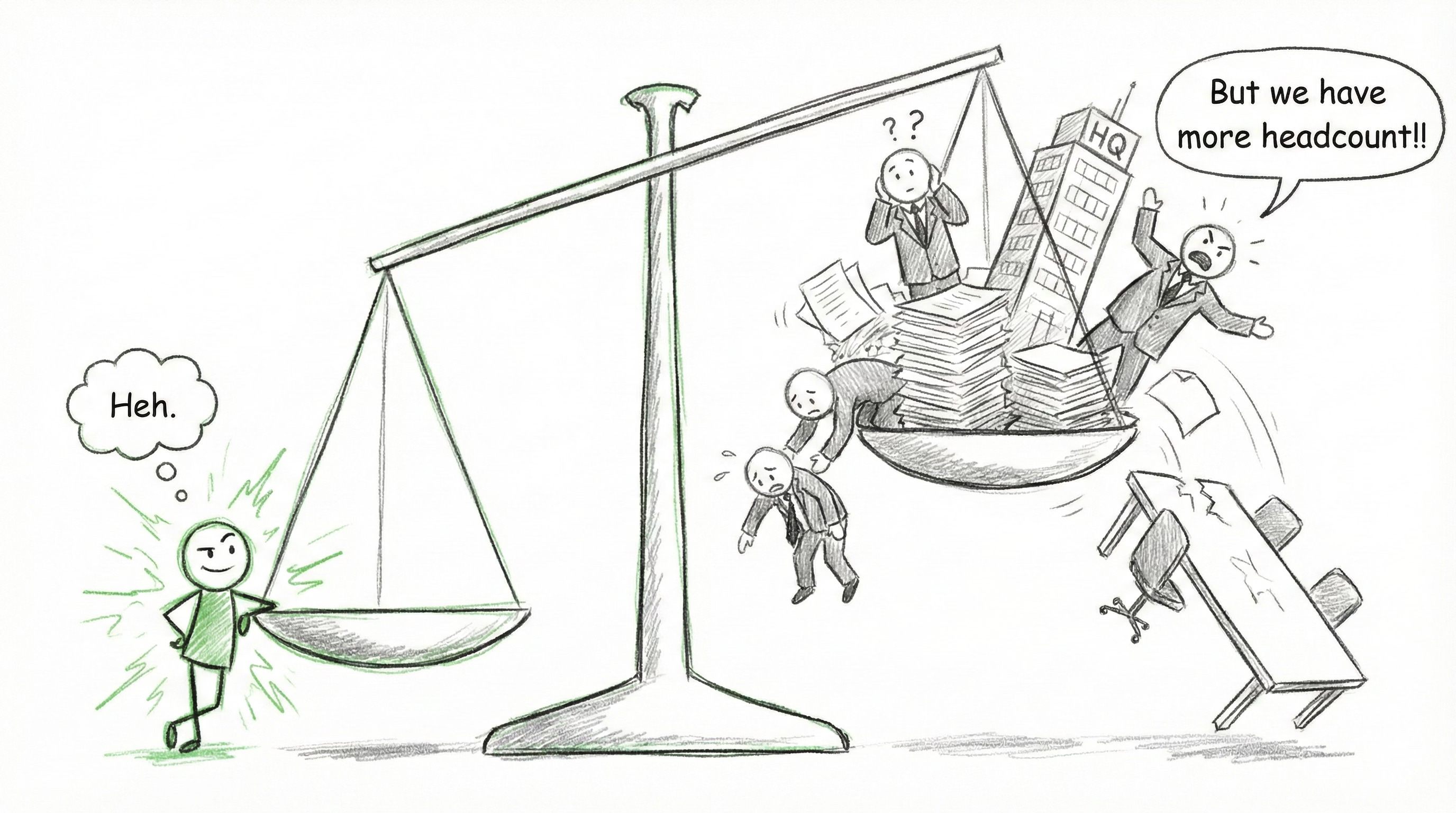
Edwin has this radical idea that if you fired 90% of the people at Big Tech companies, they’d actually move faster.
As someone who once spent three hours in a meeting to plan the agenda for a different meeting, I feel seen. And slightly attacked.
Surge hit that $1 billion mark with roughly 60 to 70 people. Do the math. That is mind-bending revenue per employee. Edwin’s philosophy is that talent density + AI leverage > an army of average workers.
He treats hiring like a last resort, not a status symbol.
In the corporate world, we usually measure power by headcount. “Oh, Karen? She manages a team of forty.” We assume Karen is important. But in the Edwin Chen universe, Karen is just inefficient.
For us, running our own internal operations, this is the ultimate permission slip to stay lean.
We used to think we needed a “team” to do big things. We’d wait for budget approval to hire a junior analyst or a designer. But if Surge can power the world’s frontier AI labs with a team that could fit on a single school bus, we definitely don’t need to wait for permission to execute.
The goal isn’t to build a kingdom of direct reports. The goal is to be a special forces unit of one, armed with enough AI leverage to outproduce a department of ten.
2. The “Poetry Problem” (Taste is the only moat)
Here is where I usually fail.
I love a checklist. If I have a task, I want to check the box. Done. Next.
But Edwin argues that “checking the box” is exactly what makes AI—and humans—mediocre. He gives this great example about poetry.
If you ask an AI (or a disinterested employee) to “write a poem about the moon,” they will look at the requirements:
Is it about the moon? Yes.
Does it rhyme? Yes.
Is it 8 lines long? Yes.
Job done. Quality achieved.
Except it’s not. It’s usually a hostage note with rhymes.
Surge became essential to companies like Anthropic and Google not because they churned out data, but because they understood Taste.
They defined quality not by “did you follow instructions,” but by “did this evoke emotion? Did it surprise you?”
This is terrifying for me because I can’t automate “taste.” I can’t pip-install “sophistication.”
But it’s also the massive opportunity. As AI drives the cost of “average work” to zero, the value of Discernment goes to infinity.
If our output looks like we just followed a standard operating procedure, we are replaceable. Our job, running our internal business, isn’t just to produce the deliverable. It’s to be the arbiter of what is actually good. We have to be the ones who say, “Technically this meets the brief, but it has no soul. Do it again.”
3. Optimizing for Truth vs. Dopamine
I have a confession. I spent twenty minutes yesterday trying to get an AI image generator to make my headshot look “cool but approachable,” instead of doing the deep research I needed to do.
I was optimizing for dopamine.
Edwin points out that the entire industry is doing this. Models are being trained to be “chatty” and “pleasing” rather than brutally accurate. He calls it “optimizing for dopamine instead of truth.”
He built Surge by ignoring the dopamine hits.
He didn’t chase VC funding (the ultimate founder dopamine).
He didn’t post performative threads on Twitter (the ultimate ego dopamine).
He didn’t optimize his product for flashy benchmarks that don’t matter.
He just focused on the unsexy, boring reality of high-quality data.
It’s easy to fall into the trap of “performative work.” You know, the stuff that looks like work but is actually just procrasti-branding. Tweaking the font on the slide deck. Re-organizing the Notion workspace for the fifth time.
Edwin’s $1 billion lesson is to ignore the “Silicon Valley Game” (or in our case, the “Office Politics Game”).
The market—whether that’s actual customers or our internal stakeholders—eventually stops caring about the flash. They care about the truth. Does the thing work? Is the data good? Did we solve the problem?
We have to be the ones in the room who stop chasing the engagement metrics and start chasing the actual result. Even if it’s boring. Especially if it’s boring.
The Wrap Up
So, the bad news is I have no excuse for not delivering massive value just because I’m “one person.”
The good news? The playbook is simple.
Stay lean: Leverage is better than headcount.
Cultivate taste: Be the editor, not just the creator.
Ignore the dopamine: Do the boring, true work.
I’m going to go apply this right now. Immediately after I ask ChatGPT to rewrite this email three more times to make me sound smarter.
Old habits die hard.
Links:
https://www.edwinchen.ai
https://surgehq.ai
How A Google Alum Became An AI Billionaire And The Youngest Member Of The Forbes 400
Surge CEO & Co-Founder, Edwin Chen: Scaling to $1BN+ in Revenue with NO Funding
How this 100-person company became essential to Anthropic, Google, and frontier AI labs | Edwin Chen


