

Evening, CEO!
While I was busy debating whether it was socially acceptable to eat cereal for dinner three nights in a row, a startup called Harmonic did something ridiculous.
They built an AI named Aristotle.
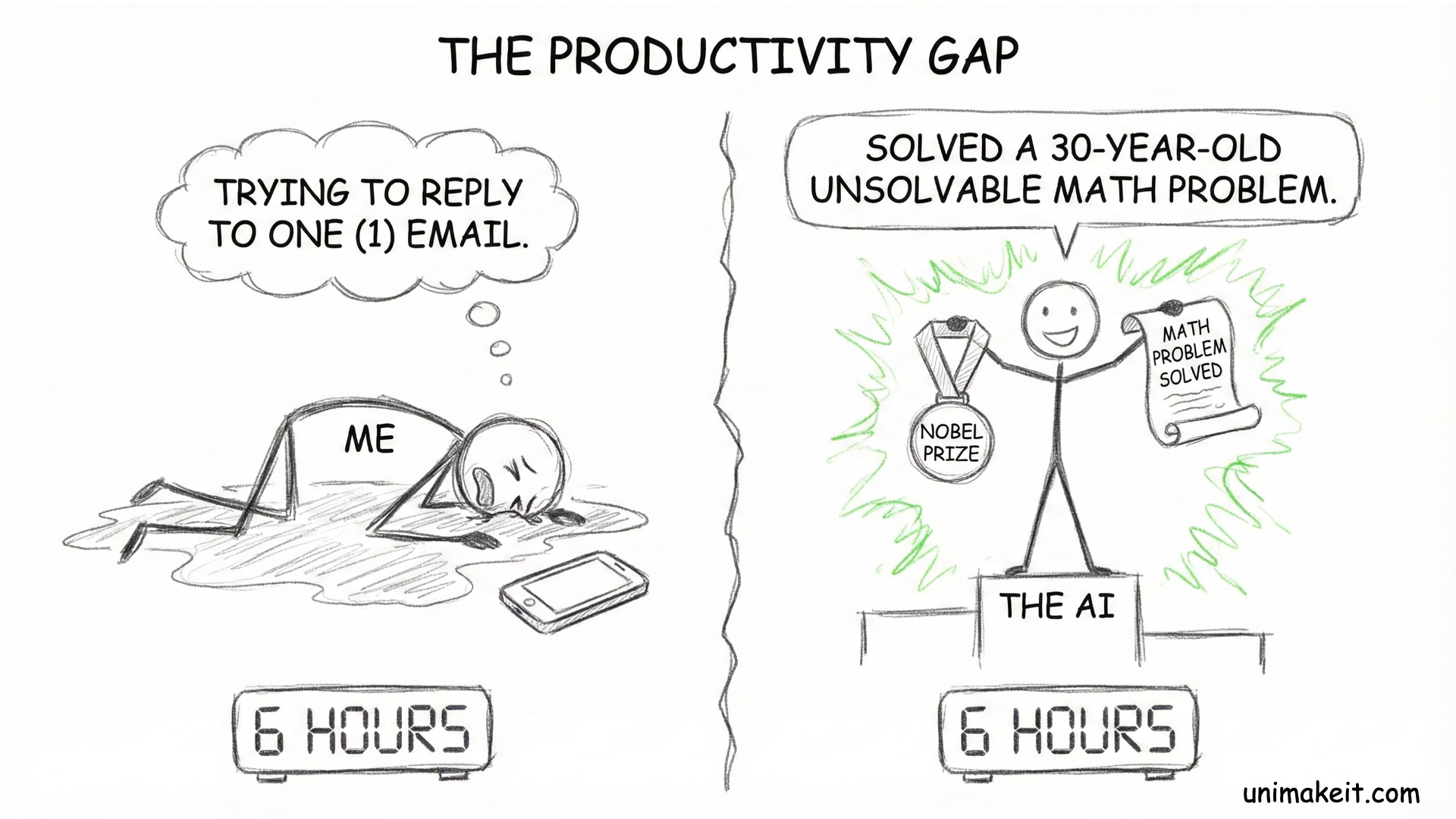
They pointed Aristotle at a math problem that has baffled the smartest humans on Earth for 30 years.
Aristotle solved it in 6 hours.
The company, Harmonic, is valued at $1.45 billion.
Let’s look under the hood, because they didn’t just solve a puzzle—they solved the one thing AI has been terrible at: Trust.
1. The Trap of the “Swiss Watch”
First, let’s understand the problem without my brain melting out of my ears.
Imagine you open a bank. But you are a chaotic agent of chaos, so you only have two printing presses.
Printer A: Only prints powers of 3 ($3, $9, $27, $81...)
Printer B: Only prints powers of 4 ($4, $16, $64...)
The question (Erdős Problem #124) was basically: If we mix all these weird bills together, can we pay for literally anything? Can we make $100? $101? $102? Forever?
For 30 years, human mathematicians looked at this and panicked.
They saw “odd numbers” and “even numbers.” They saw prime factors. They tried to fit these numbers together like a microscopic Swiss Watch. They were looking for Structure.
They were obsessed with how the gears fit together.
I do this all the time. I spend three hours looking for the “perfect” Notion template to organize my life, instead of just... organizing my life.
The humans were stuck because they were playing “Hard Mode.” They assumed the solution had to be elegant. They assumed the “Great Erdős” wouldn’t ask a question unless the answer was a beautiful symphony of logic.
Spoiler: It wasn’t.
2. The “Dump Truck” Method
Aristotle, the AI, has zero appreciation for beauty. It does not care about symphonies.
It looked at the problem and effectively said, “You guys are nerds. Move over.”
Instead of trying to build a Swiss Watch, Aristotle used the Dump Truck Method.
Its logic was embarrassingly simple:
Take all the bills ($1, $3, $4, $9, $16...).
Throw them in a pile on the floor.
Sort them from smallest to largest.
Then it applied a “Greedy Algorithm” (which is also the name of my diet plan).
The logic:
Imagine you have successfully paid for everything up to $100.
The next bill in your pile is $50.
Can you make $101? Yes. You take the $50, and you already know how to make $51 from the previous pile.
As long as the next bill isn’t bigger than the sum of all previous bills (plus 1), you never have a gap.
That’s it.
The humans were trying to play a perfect game of Tetris to fill a hole.
The AI drove a dump truck full of sand and backed it up to the hole.
It proved that if the sand (the numbers) is dense enough, the hole gets filled. It didn’t care about the shape of the sand. It just cared about the volume.
While I’m over here trying to craft the “perfect email,” this AI just proved that brute force volume often beats elegant strategy.
3. Sobering Up the Drunk Intern
Okay, so it solved a puzzle. Why is the company worth $1.45 billion?
Because of Trust.
We all love ChatGPT. But let’s be honest—ChatGPT is like a brilliant, confident, slightly drunk intern.
You ask it for a legal precedent, and it nods enthusiastically.
Remember that lawyer in New York? He asked ChatGPT to write a brief against Avianca Airlines. ChatGPT spit out Varghese v. China Southern Airlines.
It sounded real. It had a case number. It had a date. It had a ruling.
The lawyer submitted it to a federal judge.
The problem? The case didn’t exist. ChatGPT had hallucinated the entire thing.
That is “Vibe Proving.” It feels right, right up until the judge realizes you’re citing a ghost.
In poetry, vibes are great.
In financial trading algorithms or chip architecture? Vibes get you fired and sued.
Harmonic built something different.
They built a Strict Librarian into the code.
Aristotle generates ideas (the drunk intern part), but before you see anything, it has to pass through a “Verifier” written in a programming language called Lean 4.
Think of Lean 4 as a grumpy TSA agent.
If there is a single logical flaw, the agent screams “ACCESS DENIED” and the answer is deleted.
The user only sees the answer that passed.
This is the billion-dollar moat.
They industrialized Certainty.
Most of us are selling “Vibes” in our jobs. “I think this marketing campaign will work.” “I feel like the code is solid.”
Harmonic proved that if you can wrap your work in a layer of “Mathematical Proof”—where the result is guaranteed—your value skyrockets.
The Takeaway
The AI didn’t win because it was smarter. It won because it wasn’t embarrassed to be simple.
Humans tried to be architects; the AI was happy to be a paver.
If you are stuck on a project today, stop trying to build a Swiss Watch. Just get the dump truck. Fill the hole with sand.
And if you can find a way to verify your work so your boss never has to double-check it?
You might just become a unicorn yourself.
Links:
https://x.com/vladtenev
https://harmonic.fun
https://techcrunch.com/2025/07/28/harmonic-the-robinhood-ceos-ai-math-startup-launches-an-ai-chatbot-app
https://www.reuters.com/business/robinhood-ceos-math-focused-ai-startup-harmonic-valued-145-billion-latest-2025-11-25
https://www.erdosproblems.com/forum/thread/124
https://x.com/thomasfbloom/status/1995094668879462466
https://mathstodon.xyz/@tao/115639983683442577
https://arstechnica.com/tech-policy/2023/05/lawyer-cited-6-fake-cases-made-up-by-chatgpt-judge-calls-it-unprecedented/


