

Morning, CEO!
Here’s a number that made me spill my third cup of coffee: 100 Million RMB (about $14M USD).
That’s how much funding Sengine Technology raised.
Here’s the kicker: Their main product—a game called SenBOX—hasn’t even officially launched yet. But it already has millions of fans and is generating revenue.
The founder, Zidong Liu, is a Gen Z Ph.D. dropout who looked at the AI landscape, saw Google and OpenAI fighting to the death, and said, “Nah, I’m good.”
Today, we are stealing his playbook on how to win by refusing to fight.
1. Stop Polishing the Old Battlefield
If you’re anything like me, you probably spend a decent chunk of your week trying to get slightly better at things that everyone else is also doing.
We optimize our email subject lines. We tweak our Midjourney prompts to get the lighting just right. We try to squeeze 5% more productivity out of a Tuesday.
Zidong Liu calls this “fighting on the Old Battlefield.”
He looked at the history of the internet like a ladder of “Information Density”:
Text (1.0): Blogs. Low bandwidth.
Images (2.0): Instagram. Prettier, faster.
Video (3.0): TikTok. The current king.
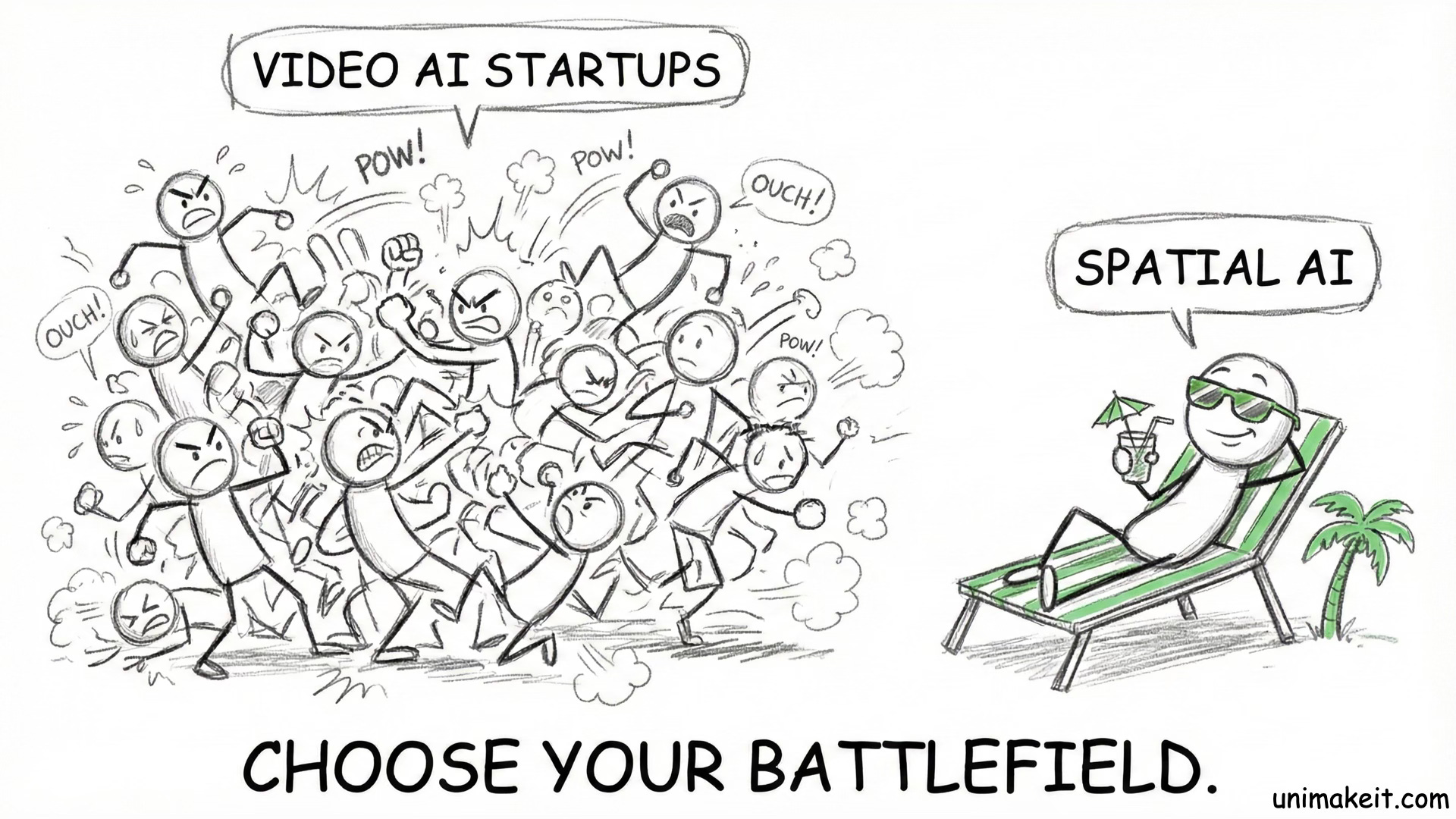
Right now, every major AI company is bludgeoning each other trying to win the Video war. It’s a bloodbath.
Liu realized that if he tried to build a “better video generator,” he’d just be another casualty. So he went to the Next Continent: Space.
Not outer space. 3D Space.
While everyone is fighting over pixels, he’s betting on Voxels (3D pixels). He realized that “Space” is the only modality left that offers higher dimension and interaction than video.
The CEO Takeaway:
Look at your current “business” (your job). Are you trying to be the best at a skill that is currently being commoditized? Are you fighting trench warfare?
Stop trying to do the “Old Modality” 10% better. Find the “New Modality” where no one is looking yet. Be the only person in your department using AI to generate video updates while everyone else is still typing memos.
2. The “Skeleton” vs. The “Skin”
Here is where my brain did a little backflip.
Usually, when we think of 3D AI, we think of “making things look pretty.” We think of textures, lighting, and rendering. We think of the Skin.
Liu thinks this is a trap.
There are massive labs (like Fei-Fei Li’s World Labs) working on visually perfect 3D scenes.1 But Liu argues that a pretty room is useless if the AI doesn’t understand how humans actually live.
If you ask an AI to “generate a living room,” a visual model might give you a stunning image where the sofa is facing the wall and the TV is on the ceiling. It looks real, but it’s logically insane.
Sengine ignores the Skin and focuses on the Skeleton:
What do we place?
Where do we place it?
He treats furniture layout not as a design problem, but as a Recommendation System problem. Just like TikTok recommends the next video based on your viewing history, Sengine recommends the perfect spot for that armchair based on flow, privacy, and sunlight.
The CEO Takeaway:
In your work, are you focusing on the “Skin” (the deliverables, the slide deck design, the final report)?
The value is in the “Skeleton” (the logic, the structure, the why). AI can generate the skin instantly. The person who owns the skeleton owns the project.
3. The “Rainforest” Strategy (Or: How to Trick Robots)
This is my favorite part. It’s devious.
Liu wants to train robots. Specifically, domestic robots that can fold laundry and find your lost keys.
The problem? Data scarcity.
Self-driving cars have endless hours of GoPro footage from roads. But we don’t have cameras inside millions of people’s bedrooms (thankfully). So, how do you train a robot to navigate a messy bedroom without crashing?
He built a video game.
SenBOX is basically an AI-powered Minecraft or The Sims. Users—mostly young women—spend hours designing their dream homes, placing furniture, and creating layouts.
They think they are playing a game.
Liu knows they are generating training data.
He calls this the “Rainforest Strategy.”
SaaS is a desert where only the biggest survive (Winner Take All).
Gaming is a rainforest. There are elephants (AAA games), but there are also millions of ants (indie games). Even the ants eat well.
He builds a game to survive and make cash. The game generates the data. The data trains the “Spatial Intelligence” model. Then, he sells that intelligence to B2B giants like Panasonic and robot manufacturers.
He treats the B2B revenue as a “side hustle” while the game keeps the lights on.
The CEO Takeaway:
What is the “Game” you can play that generates value for your “Real Mission”?
Maybe you start a newsletter (The Game) to force yourself to learn AI (The Mission). The newsletter might make a few bucks, but the data (the skills you learn) is what gets you the promotion or the big contract.
The Bottom Line
Zidong Liu didn’t win by fighting harder. He won by looking at the map, seeing where the crowd was heading, and walking the other way.
He bet on Space over Video. He bet on Logic over Looks. He bet on Play over Pitching.
I’m going to go stare at a wall now and think about my life choices. Or maybe I’ll just go play SenBOX and pretend it’s market research.
Links:
https://sengine.ai/home
https://sz.ifeng.com/c/8h4iqdSIxac
https://www.douyin.com/video/7572100056153689394
https://mp.weixin.qq.com/s/f2OkjTa2qQh4CuP6EwSaFQ


