

Evening, CEO!
While I was drafting a “polite follow-up email” to a mid-level manager so I wouldn’t seem too pushy, a 13-year-old named Michael Goldstein was busy taking a meeting with Sam Altman.
Yes. Thirteen.
He’s not just doing homework; he’s pitching VCs in San Francisco, pivoting startups, and getting investment advice from the CEO of OpenAI.
He is the founder of Flow AI (and now Kodo). He has zero degrees. He has zero “corporate experience.”
And he is absolutely crushing it.
Today, we are stealing his playbook. Because if a kid who still has a curfew can build this much leverage, we have officially run out of excuses.
1. The Art of “Vibe Coding” (Or: How to fake wizardry)
I was raised in the era where you had to “understand the underlying logic” before you were allowed to build the fun stuff.
Michael? He doesn’t really code.
Well, he admits he can “half-code.”
Instead, he subscribes to a philosophy coined by Andrej Karpathy called “Vibe Coding.”
It sounds like a joke, but it’s actually the future of our work.
Vibe Coding is when you stop trying to be the bricklayer and start being the architect. You use tools like Cursor (an AI code editor) or Claude, and you just... describe the vibes.
You describe the functionality. You describe the outcome. You embrace the exponentials and forget the code even exists.
Michael built his products by watching YouTube tutorials and letting the AI do the heavy lifting.
We cherish our “hard skills.” We wear our struggle like a badge of honor. “I learned to do this the hard way!” we scream, shaking our fists at the cloud.
Michael doesn’t care.
He treats coding the same way I treat ordering a pizza. I don’t need to know how to knead the dough; I just need to know what toppings I want.
Stop trying to learn the syntax of the tool. Master the logic of the product.
Your value isn’t in typing the code (or writing the email, or formatting the spreadsheet). Your value is in knowing whatneeds to be built.
Shift from “How do I do this?” to “What do I want this to do?”
Let the AI handle the “How.”
2. Audacity is a Strategy (The “Cold Email” Superpower)
If I want to contact an industry leader, I usually spend three weeks drafting an email.
Then I delete it.
Then I write it again.
Then I decide I’m “bothering them” and go eat a cookie instead.
Michael wanted to pitch his AI agent. So he emailed Sam Altman’s assistant.
He didn’t just get a generic “thanks for reaching out” auto-reply. He got invited to OpenAI headquarters.
He got a tour.
He sat in Sam Altman’s office.
And then—this is the part that makes me want to hide under my desk—he asked Sam: “I’m running out of money. How much should I ask for?”
Sam told him to go ask a16z (one of the biggest VC firms in the world) for $100,000.
So Michael did.
He didn’t get the money (yet), but he got the meeting. He got the network. He got the visibility.
The “Permission Police” do not exist.
As we get older, we accumulate this invisible weight of “Professional Etiquette.” We convince ourselves there are gatekeepers everywhere. We think we need a warm intro, a 10-year track record, and a fancy title before we are allowed to speak.
Michael proves that the gatekeepers are mostly imaginary. Or, at the very least, they are very confused by audacity.
When you act with total agency—when you treat the CEO of OpenAI like a helpful guidance counselor—people tend to just... go along with it.
Stop waiting for someone to invite you to the table. Just walk in and ask where to sit.
3. Experience is Heavy Luggage (Drop it)
I have two decades of “professional development” and a LinkedIn profile that I’m terrified of ruining.
I have “experience.”
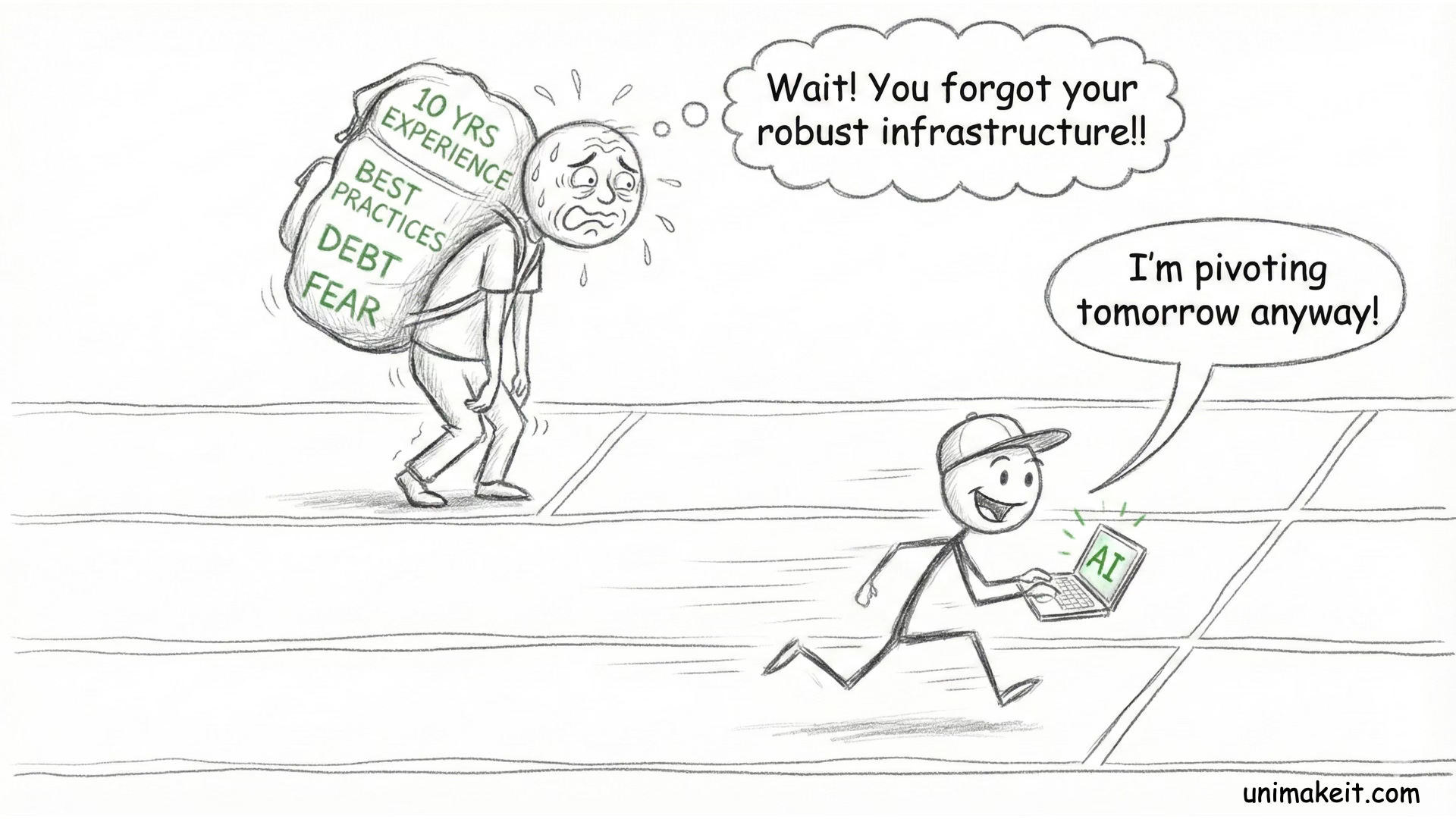
And sometimes, that experience is just a giant backpack full of rocks that I carry around, slowing me down.
Michael has no backpack.
He launched a startup called “Neatly.” It was an agent that controlled computers.
It was hard. It was buggy.
Did he spend two years trying to fix it because of the “Sunk Cost Fallacy”? Did he hold onto it because it was his “baby”?
No.
He realized the market was crowded. He realized the tech wasn’t quite there.
So he pivoted. Immediately.
Now he’s building “Kodo,” an AI design agent.
He treats his business ideas like Lego sets. If one isn’t working, he doesn’t cry about the bricks. He smashes it apart and builds a spaceship instead.
Speed > Seniority.
We mid-career folks love to over-plan. We love to build “robust foundations.” We love to make sure everything is perfect before we launch, because we are terrified of looking foolish.
We are protecting our “reputation.”
Michael doesn’t have a reputation to protect. He just has speed.
In the AI era, the ability to pivot—to throw away what you worked on last week because a new model came out this morning—is the ultimate competitive advantage.
Don’t fall in love with your first draft. Don’t fall in love with your current business model.
Be willing to look like a beginner. Be willing to smash the Legos.
The Takeaway
Michael Goldstein is 13.
He isn’t smarter than you. He definitely doesn’t have more resources than you.
He just hasn’t learned to be afraid yet.
He hasn’t learned that “you can’t do that.”
So, for the rest of this week, try to channel your inner 13-year-old.
Ignore the “rules.” Use the AI to do the hard work. Send the email you’re scared to send.
And if anyone asks what you’re doing, just tell them you’re Vibe Coding.
Links:
https://x.com/mlg27_
https://www.usekodo.ai
https://sfstandard.com/2025/10/20/13-year-old-ai-boom-san-francisco


