


Evening, CEO!
Meet Gabriel Petersson.
He works at OpenAI on the Sora team. You know, the AI that makes those mind-bending videos that look realer than real life?
In the corporate hierarchy, a Research Scientist role at OpenAI is basically the Iron Throne. To sit there, you usually need a PhD from Stanford, a citation count higher than the population of Wyoming, and a beard that smells like pure mathematics.
Gabriel has none of that.
Gabriel is a high school dropout.
He didn’t get the job because he knew the right people. He got the job because he used ChatGPT to teach himself PhD-level machine learning in his bedroom.
While I was busy overthinking which font to use on my resume for three weeks (I settled on Arial, thanks for asking), this kid was rewriting the rules of career capital.
Today, we are stealing his playbook.
1. The “Just-in-Time” Learning Engine
I have a toxic trait.
When I want to learn something new, I buy three books, bookmark fourteen “Ultimate Guides,” and sign up for a Coursera specialization. I then proceed to do absolutely none of them.
I call this “Just-in-Case” learning. It’s the traditional education model: stack up a bunch of knowledge bricks (Calculus, Linear Algebra, Python Syntax) just in case you might need to build a house in four years. I am essentially preparing to build a house by spending four years studying the molecular chemistry of a brick.
Gabriel operates on “Just-in-Time” learning.
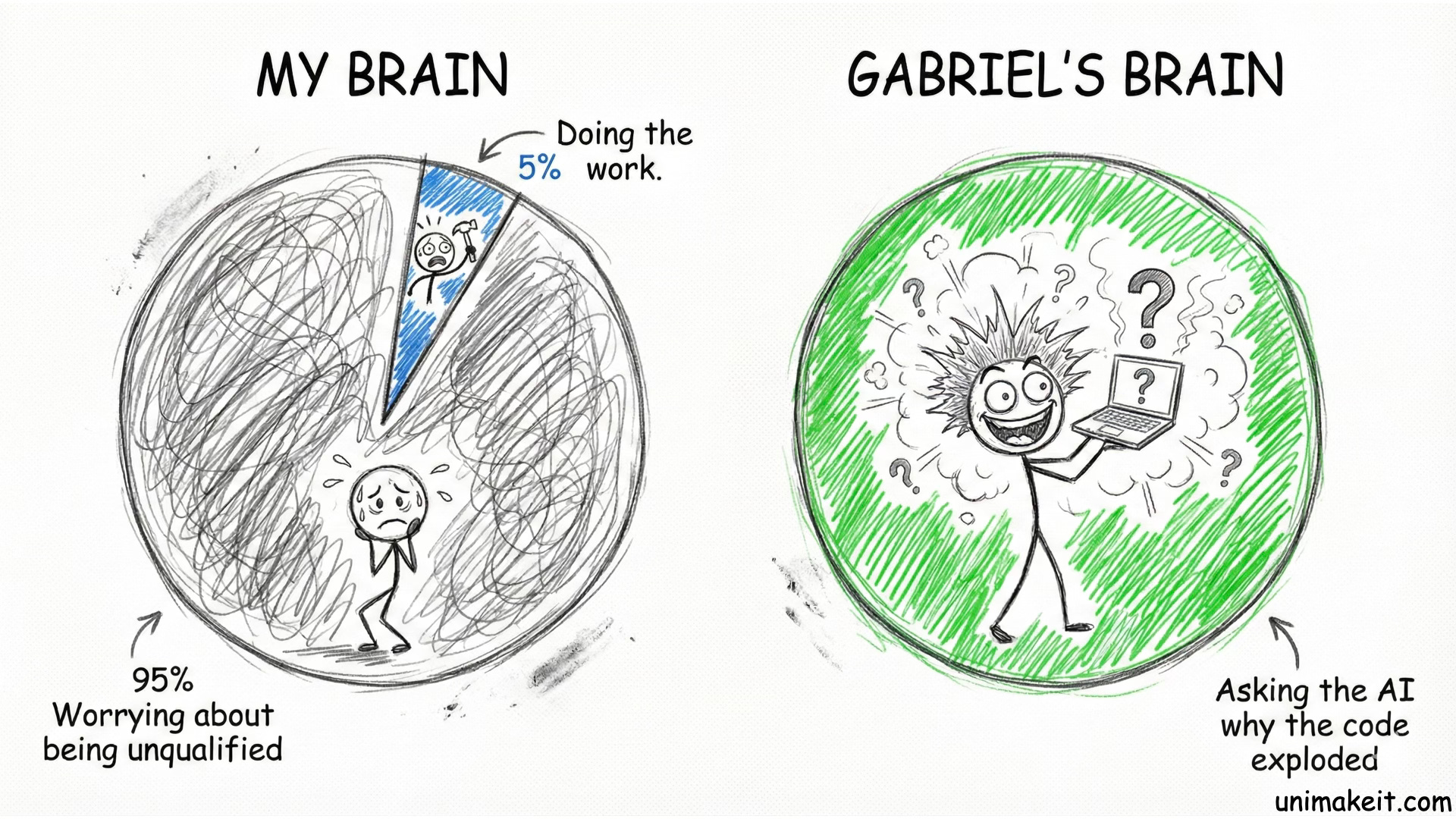
He calls it a “Top-Down” approach. He doesn’t study the math first. He picks a project that is way above his pay grade—like building a diffusion model from scratch.
Then, he runs into a wall.
He asks ChatGPT: “How do I code this?”
ChatGPT spits out code.
He runs it. It explodes.
He asks: “Why did it explode?”
ChatGPT explains the error.
He asks: “What does this specific math term mean? Explain it like I’m 12.”
He calls this Recursive Gap Filling.
He only digs into the theory when the practical application breaks. It’s like learning to play a video game by mashing buttons until you figure out the combos, rather than reading the 400-page instruction manual first.
For us, running “Agency of One”, this is liberation.
Stop hoarding knowledge. You don’t need to know how the engine works to start driving the car. You just need to know how to ask the mechanic (AI) what that weird rattling noise is when it happens.
2. Kill the Proxy, Show the Work
Here is a painful truth I’ve learned at 41: Degrees are just risk management for lazy recruiters.
A degree is a “Proxy Metric.” It’s a piece of paper that says, “This person probably won’t burn the building down.”
I treat my credentials like Pokémon cards. “Look at this shiny certificate! I caught a Master’s Degree!” But Gabriel realized early on that the market doesn’t care about your collection. The market cares about results.
Gabriel bypassed the proxy entirely.
When he wanted a job at 18 (with zero experience), he didn’t send a resume. He scraped a company’s website, built a better product recommendation system for them on his own time, walked to their office, and showed them the A/B test results.
He didn’t say, “I am a hard worker.” He said, “Here is how I made you money.”
Even when he needed an O-1 Visa (the “Extraordinary Ability” visa usually reserved for Nobel Prize winners and Olympic athletes), he didn’t have academic papers.
When the front door is locked (no degree), most people go home. Gabriel checked the chimney.
He hacked it. He used his Stack Overflow answers. He argued that his code solutions, viewed by millions of developers, were “scientific contributions.” The US Government looked at the data and said, “Fair enough. Welcome to America.”
Gabriel’s philosophy is simple: “Companies just want to make money. You show them how to make money, that you can code, and they’ll hire you.”
Stop polishing the menu. Cook the meal.
3. Agency is the New IQ
I used to think being smart meant having a high IQ.
Now I realize being smart in the AI era means having High Agency.
High Agency is the ability to look at a reality that says “No” and force it to say “Yes.”
I have historically had Low Agency. I once apologized to a chair I bumped into. Low Agency people wait for a syllabus. They wait for permission. They wait for someone to tell them the steps.
Gabriel treats AI not as a cheat code to do the work for him, but as a staff member that helps him understand the work.
He creates a manic Feedback Loop.
Most of us wait weeks for feedback. We submit a report, wait for the boss to read it, get a few comments, cry in the bathroom, and revise.
Gabriel gets feedback every 30 seconds.
He keeps a tab open with ChatGPT constantly. He asks it 100 questions a day.
“Is this code optimized?”
“What’s a better way to do this?”
“Roast this logic.”
He compresses years of learning into months because his iteration speed is terrifyingly fast.
While I’m worrying about looking stupid in front of a human mentor, Gabriel is asking his AI mentor the “stupid” questions over and over until he becomes undeniable.
This is the ultimate leverage. You have a staff of geniuses available 24/7 for $20 a month.
If you aren’t using them to accelerate your own competence, you aren’t being outsmarted. You’re being out-hustled.
The Takeaway
I often feel like a potato compared to the “AI Natives” growing up today.
But Gabriel’s story proves the boat hasn’t left. The rules of the river have just changed.
The advantage has shifted from the Credentialed (who rely on past permission) to the Curious (who rely on present action).
You don’t need a PhD to build the future. You just need to be brave enough to start building it before you feel “ready.”
Pick one project you’ve been putting off because you “don’t know how to do it yet.” Start it now.
Ask the AI to teach you step one.
Then step two.
Links:
https://gabriel.petersson.website
https://sora.chatgpt.com
https://www.plymouthstreet.com/stories/gabriel-petersson
https://www.businessinsider.com/high-school-dropout-openai-chatgpt-learn-ai-gabriel-petersson-2025-11
High School Dropout to OpenAI Researcher - Gabriel Petersson Interview


