


Evening, CEO!
Imagine hitting $1 million in revenue. You pop the champagne. You buy a monocle. You think you’ve made it.
Then you realize getting to $10 million requires a completely different brain.
This is the “Valley of Death” for startups. Most die there.
Today, we’re stealing the playbook from Jen Abel. She’s the expert who drags B2B founders across that valley. She teaches them how to land $100k deals with Fortune 500 giants when they are just a tiny team with a janky product.
Here is how we apply her enterprise sales logic to our own operations.
1. Stop Selling the Mushroom. Sell Mario on Blast.
I have a bad habit. When I build a cool AI tool, I run to a stakeholder and say, “Look! It parses PDFs 40% faster!”
Their eyes glaze over. They start thinking about what they’re going to order for lunch.
Jen Abel calls this Problem Selling. It focuses on fixing something broken. It’s what mid-level managers care about.
But if you want to sell to the C-Suite (or get the big budget/promotion), you have to do Vision Casting.
There’s a famous diagram from game designer Kathy Sierra:
The User: Mario (small, sad).
The Product: The Mushroom.
The Result: Super Mario throwing fireballs.
Most of us spend our careers trying to sell the Mushroom. “Look at the texture! Look at the nutritional value!”
Nobody cares about the mushroom. They want to throw fireballs.
When you pitch your next initiative, stop talking about efficiency or “fixing bugs.”
Talk about Alpha.
Don’t say: “This AI generates marketing images cheaply.”
Say: “This engine lets us run 500 experiments a week instead of 5. While our competitors are arguing over one campaign idea, we will have already failed 499 times and found the one that prints money.”
Sell the superpower. Sell the fireball.
2. The “Goldilocks” Fallacy
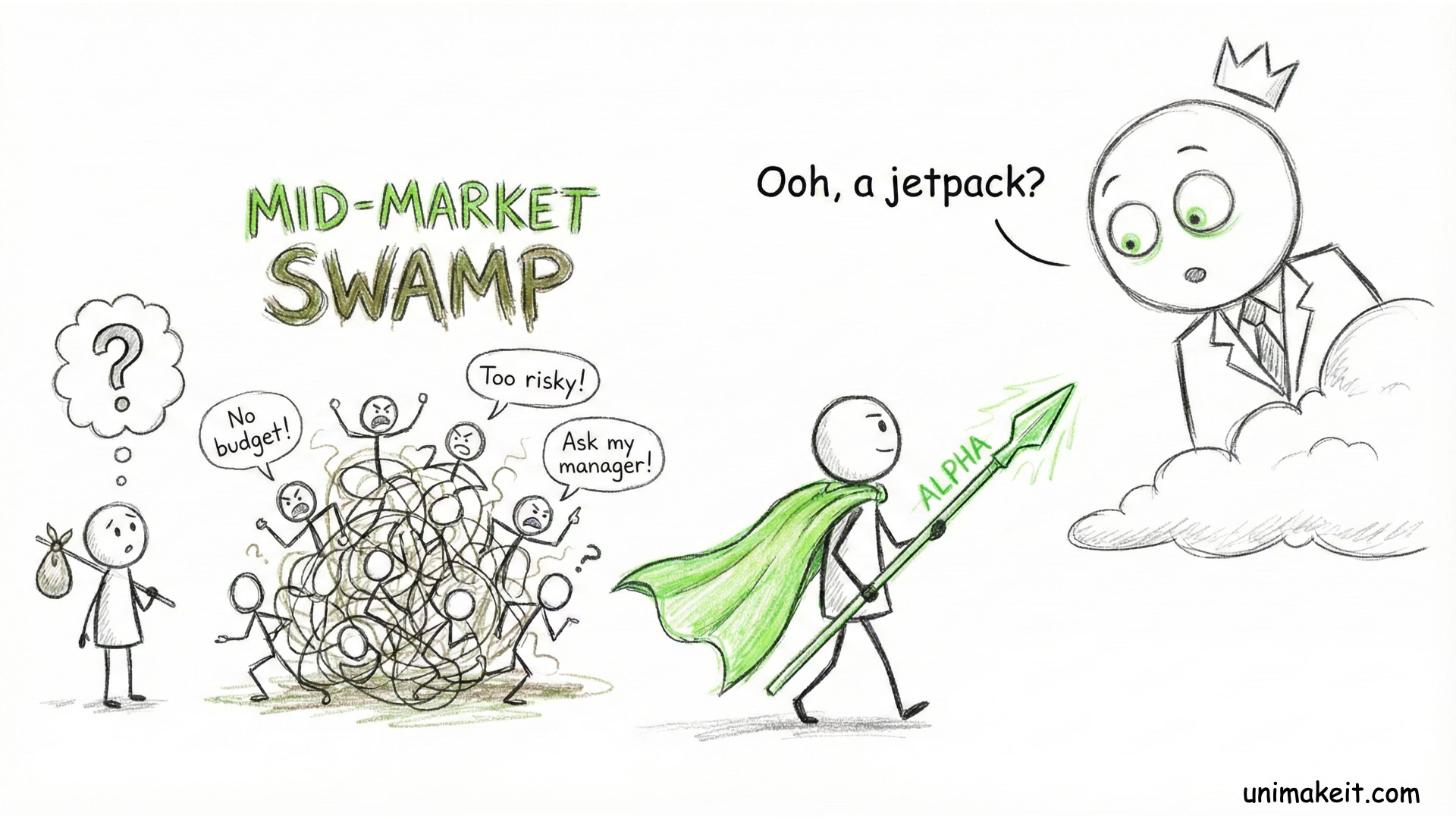
There is a comforting lie we tell ourselves: “I shouldn’t ask for too much. I won’t go after the tiny guys, but I’m too scared for the big guys. I’ll aim for the middle. It’s safer.”
Jen Abel says the mid-market is a myth.
It’s a trap.
If you try to play in the middle, you get crushed. The middle is where bureaucracy lives, but budgets go to die.
Instead, Jen suggests something that sounds insane: Go after the Giants.
Target Walmart. Target Tesla. Target the companies that seem terrifyingly out of your league.
Why?
Because staying at #1 is actually harder than getting there.
Small companies want a “better” tool because they are trying to survive. Mid-sized companies want a “safe” tool because they are terrified of making a mistake.
Giants want a different future.
Paradoxically, the Giants are often the true early adopters. They have the budget to take risks, and they are paranoid about irrelevance. If you can sell the “Gap”—the space between where they are and where the industry is going—they will move faster than a 50-person startup.
Don’t sell them a faster horse. Sell them the jetpack.
3. The $10k Safety Blanket
Picture this: You finally get a meeting with a Giant.
Your Imposter Syndrome kicks down the door and screams, “Offer them a cheap pilot! Make it $10,000! Then they won’t say no!”
I have done this. I have undercharged because I wanted to be “nice” (read: cowardly).
Jen says this is a disaster.
A $10,000 deal is a toy. It’s a rounding error. If the project fails, the client shrugs and moves on.
You want to price between $75k and $150k.
Why? Because at $100k, the client has “skin in the game.”
If they spend six figures on you, they need you to succeed. Their reputation is on the line. They will fight internal bureaucracy to make your implementation work because they can’t afford to look like they wasted serious money.
High pricing isn’t greed. It’s a filter for seriousness.
And when you finally do hire that sales person (after you’ve done the hard work)?
Don’t hire the corporate VP who relies on a massive brand name to open doors. Hire someone who can “Cosplay the Founder.”
Find the person with high curiosity and low inhibition who believes in your vision so much they can sell the dream, not just the feature list.
The Wrap Up
The world is full of people building great things in the dark. But value is created when you step into the light and articulate that value to the people who need it most.
To scale yourself from “freelancer” to “enterprise,” you have to break the standard rules:
Stop selling features. Start selling Superpowers.
Stop playing it safe in the middle. Go hunt the Giants who need to stay #1.
Stop charging “toy” prices. Charge enough to make them care about the outcome.
Your Imposter Syndrome can wait in the car.
Links:
https://x.com/jjen_abel/highlights
https://www.jjellyfish.com


