


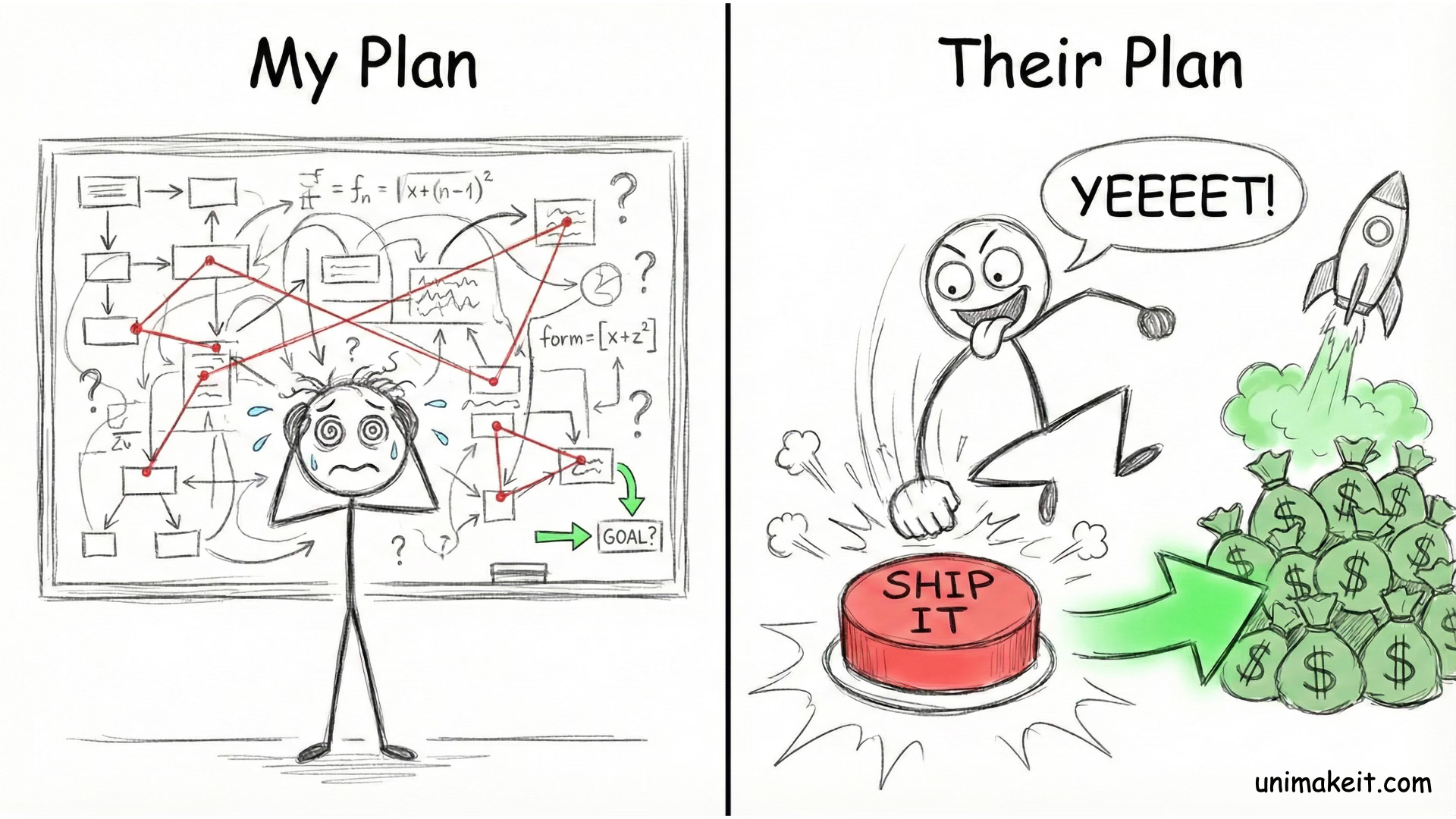
Evening, CEO!
You know Joshua Xu, CEO of Heygen, the company that makes all those AI Avatar videos.
They hit $1M ARR (Annual Recurring Revenue) in April 2023.
By October 2025, they hit $100M ARR.
And they’ve been profitable since 2023.
While most AI companies are just giant, glamorous money-bonfires, HeyGen is... actually a business.
But the real story is this 4,000-word manual Joshua released.
It’s not a fluffy “mission statement.” It’s the literal, unvarnished playbook.
It’s the “how we build things and win” document.
And it basically invalidates every workflow I’ve ever been a part of. Let’s dive in.
1. Stop trying to build on a “stable foundation.” It doesn’t exist anymore.
This is... difficult to hear.
Traditional software: Build a perfect, stable architecture that will last for 10 years.
HeyGen’s way: The AI foundation will completely change every 3-6 months.
The ground is liquid. Stop trying to build a house on it. Build a boat.
They design their products to automatically get better when the underlying models improve. They expect change.
To be clear: They embrace technology instability. They are maniacs about product stability. No bugs. No downtime.
2. Move fast AND be the absolute best.
I hear this as a contradiction.
“Fast” is what I do when I realize I have 20 minutes to get to the airport. It doesn’t usually result in “my best.”
But their logic is painfully correct. It’s a “Quality Paradox.”
Moving fast doesn’t mean shipping junk. It means learning fast.
When your competitor ships one perfect feature, you ship five experiments.
You learn 5x faster. That learning compounds.
Soon, your “fast” product is infinitely better than their “slow” one.
Speed isn’t about shipping. It’s about learning velocity.
3. The 2-Month “Wave Cycle.”
Forget 18-month roadmaps. That’s like a medieval peasant planning his 401(k).
HeyGen’s entire planning rhythm is 2 months.
Why? Because that’s how often the AI models have a “holy crap, that’s new” update.
So: 2-month strategy. 2-week deliverables. Daily shipping.
But—and this is the part that breaks my brain—they also make 6-12 month strategic bets.
They are somehow sprinting and staring at the horizon at the same time.
I can barely walk and chew gum.
4. The 2-Person Prototype Rule.
My standard workflow:
Idea.
Meeting about the idea.
Meeting to plan the doc for the idea.
Write the doc.
Meeting to review the doc...
HeyGen’s workflow: 1 PM (or Designer) + 1 Engineer.
That’s it. That’s the team.
They build the prototype. They test it. Immediately.
Only after it’s proven to be not-terrible does it get polished to the “Grandma Test” (i.e., so simple your grandma could use it).
They actively avoid the “Consensus Trap.”
They run on “Disagree and Commit.” Which means you argue like hell, a decision is made, and then everyone executes 100%.
(I usually run on “Disagree and Complain to My Plant.”)
5. The Red Flag Detector.
They have a literal list of phrases that are “deadly sins” in an AI company.
Reading them felt like a personal attack.
🚨 “Let’s think about this more.”
(Translation: We’re already behind.)
🚨 “We need a more robust, scalable solution.”
(Translation: We need users first. You’re building a spaceship for a trip to the grocery store.)
🚨 “Let’s align all the stakeholders.”
(Translation: Get ready for a 3-week meeting death spiral.)
🚨 “This isn’t polished enough.”
(Translation: Ship it. If users care, then polish it.)
I’m pretty sure 90% of my Teams messages are just a collection of these red flags.
What Now
After reading this, my first instinct was to just copy-paste the whole thing and declare it my new personality.
But that’s the trap.
This playbook is a “reference answer,” not the “correct answer.”
It works for them—a hyper-growth B2B company with a clear product.
The real point isn’t to copy HeyGen. It’s that they are forcing you to think.
What’s changed in your world? What hasn’t?
In an age where everyone can access the same AI and the same playbooks, the only real advantage is learning faster than everyone else.
Which is a terrifying thought.
Now I need to go lie down.
Links:
https://www.linkedin.com/in/buffxz
https://www.heygen.com
https://x.com/joshua_xu_/status/1978837502787219578


