


Evening, CEO!
Three years have passed since the AI Big Bang of 2023. (My brain still thinks 2023 was last year. Wait, was it?)
We’ve seen a tsunami of AI companies rise and fall. Mostly fall.
Entrepreneurs ask me, “Is the AI race already over? Is it only for the giants?”
My usual response—if I can peel myself away from Twitter long enough to form a coherent thought—is this: Opportunity always belongs to the one who solves the “Last Mile.”
Recently, I zeroed in on Snow W. Lee.
He’s the founder of Runbear. He’s running a SaaS company that hit $400,000 in ARR (Annual Recurring Revenue) in the most competitive application space. And it’s growing fast.
His story is great because he started down the same path I would have picked (and failed at), then made a brilliant, life-saving U-turn.
Let’s unpack how Snow found the “Non-Technical Lifeline.”
1. Don’t Sell Water to a Guy Who Owns the Well
Snow is a genuine serial entrepreneur. He’s sold two companies and was a CPO at a company that hit $80 million in revenue.
In 2023, he started with a “sexy” idea: an AI Copilot for DevOps engineers.
The logic felt sound: Engineers are technical. They need efficiency. They’ll buy the tool.
The result? Crickets.
Snow discovered an awkward truth: The engineers looked at his tool and thought, “Thanks, but I can just duct-tape some APIs together myself.”
He was trying to sell water to guys who were already standing next to a perfectly good, self-drilling well. The replacement cost was basically zero.
He had to Pivot. (The business equivalent of saying, “Oops, wrong planet.”)
He turned his focus to the other 90% of the office: the non-technical teams.
Sales, HR, Customer Support, Operations.
These people don’t know code. They don’t care if the underlying model is a Transformer or just a very smart toaster.
They only care about one thing: Can this AI please, for the love of God, stop me from answering the same four questions all day?
Runbear was reborn: A tool to turn any AI model into a coworker inside Slack or Teams in 10 minutes.
He stopped selling to the well-keepers and started selling to the travelers in the desert.
2. The Real Goal: Less Thinking, Not Less People
After the pivot, Snow went after the real enemy: Cognitive Overload.
I know the pain. My brain is usually a browser with 70 open tabs, 15 of them playing conflicting music.
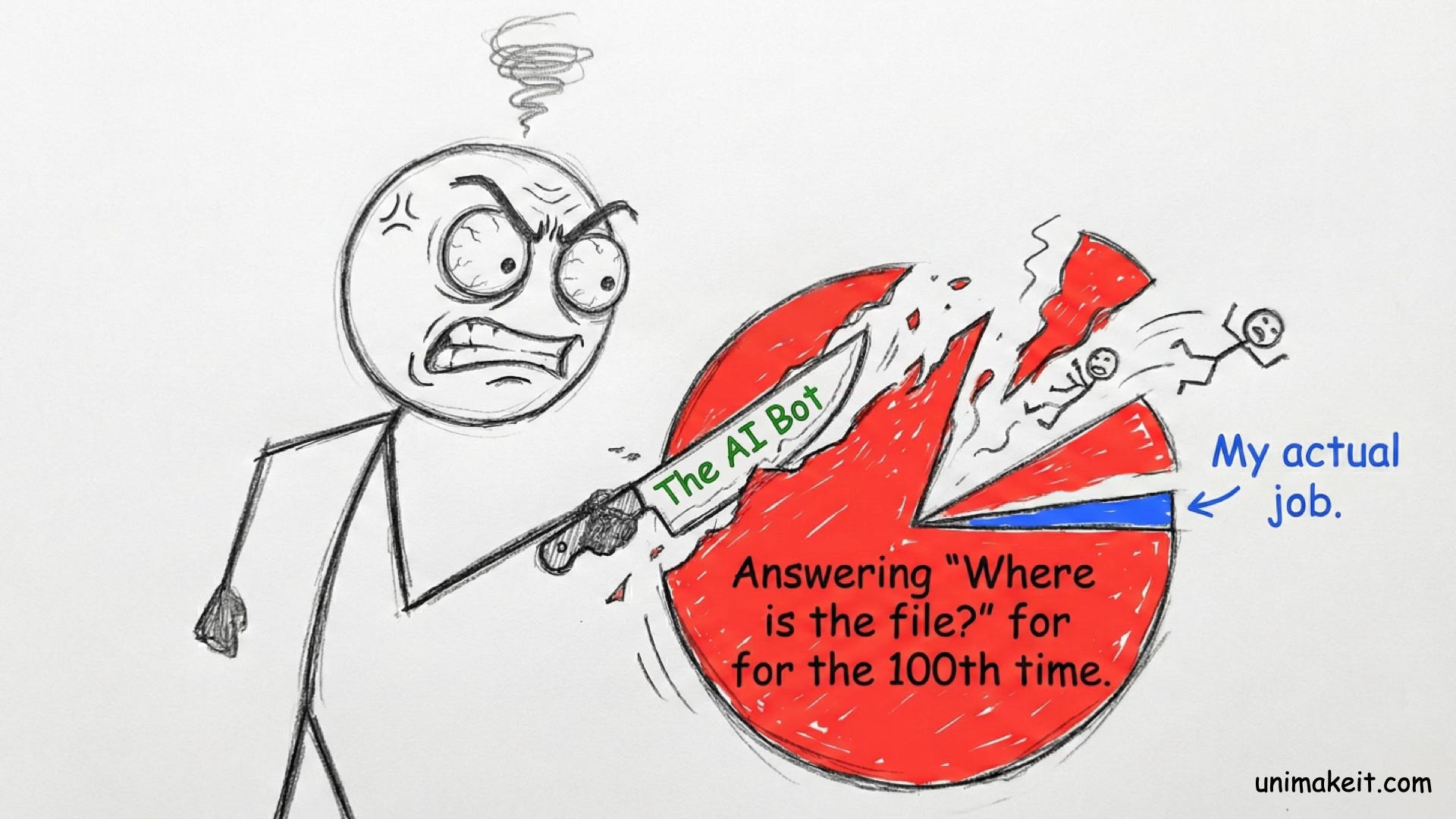
The modern workplace is a fractal nightmare of people asking, “Where is the quarterly report?” or “What’s the Wi-Fi password?”
These questions aren’t hard, but they chop your day—and your brain—into tiny, useless pieces.
And here’s the bigger problem: Human Laziness.
Getting me to open a new AI website, copy-paste my prompt, wait, copy-paste the answer back... that’s like asking me to do five push-ups just to check my email. It’s too much friction.
Snow’s insight: Don’t make them switch.
The AI needs to be where the humans already are. It needs to live inside Slack or Teams—the places we already stare at for eight hours a day.
Look at their client, LaserAway, a 3,000-person medical spa chain.
Customer service reps were constantly interrupting the medical experts with simple policy questions. The experts were going insane.
They deployed Runbear as an “AI Medical Advisor.”
Now, the AI intercepts the question first. It instantly pulls the answer from the company’s internal knowledge base. The human expert only needs to jump in if the AI is genuinely stumped.
The result? They saved 180 hours a week.
That’s four and a half full-time employees’ worth of time saved from being stuck in mundane, soul-crushing conversations.
The AI isn’t replacing people; it’s freeing the expert brains from the tyranny of the mundane.
3. The Growth Hack: Charge People to Get UN-Limited
In 2025, customer acquisition cost (CAC) is scary.
Snow shared some delightful data. He got his paid advertising CPC (Cost Per Click) down from a disastrous $1.06 to a surgical $0.15.
That is a 7X efficiency gain.
But the real growth engine was PLG (Product-Led Growth).
They focused their marketing on specific, boring scenarios: “How to draft sales emails automatically” or “How to make an IT bot in Slack.”
They charged $29/month for the basic plan.
Then came the genius moment: power users started begging to pay more to create more AI Agents.
Users literally asked to be UN-limited.
Snow realized the true pain point wasn’t price; it was the flow state. Once the AI became part of their workflow, they couldn’t risk the friction of going back.
He rolled out the enterprise plan, and the ARPU (Average Revenue Per User) shot up.
The Founder’s Lesson: Stay in Motion
Snow’s company is healthy and growing. His secret?
“Success comes from staying in motion.”
He saw the iceberg coming (developers don’t buy tools) and swerved toward the passengers who desperately needed a ride (HR and Sales).
The lesson for your “Agency of One” is simple: The moat isn’t the model. It’s human habit.
When you hit a wall, do you pivot like Snow, or do you curl up and watch YouTube?
(I’m currently on video #4, so don’t ask me.)
Links:
https://www.linkedin.com/in/ssowonny
https://runbear.io
https://www.thehomebase.ai/interviews/case-study-33-how-runbear-views-ai-as-a-knowledge-amplifier-not-a-replacement
https://www.starterstory.com/runbear-breakdown
https://www.indiehackers.com/post/tech/dialing-in-an-ai-products-icp-and-growing-it-to-400k-arr-l3XkEjvP43kuUwjxzUnd


