


Morning, CEO!
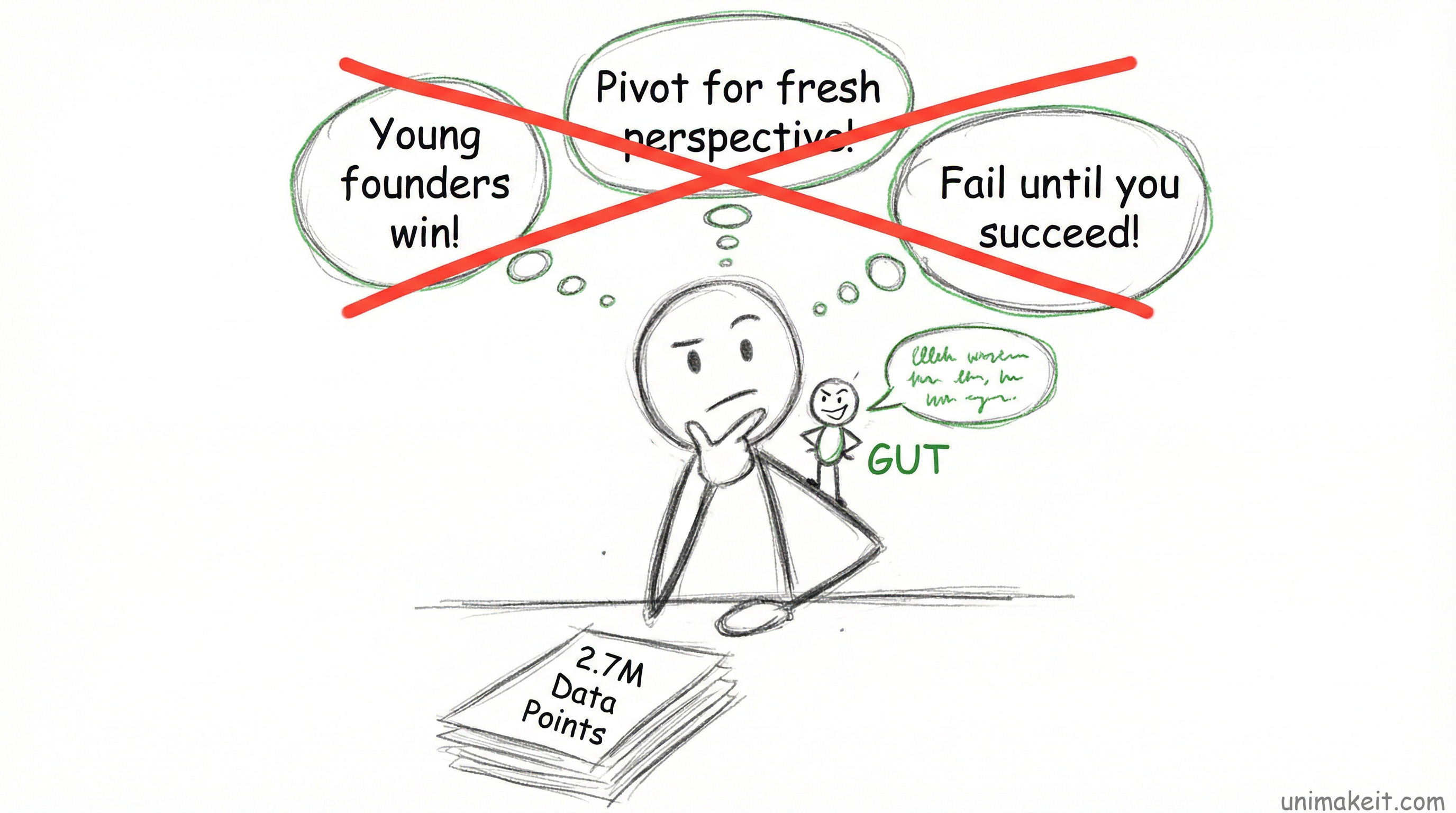
Your gut is giving you career advice right now.
It’s telling you that young founders have an edge. That pivoting industries will bring fresh perspective. That each failure is a stepping stone to success.
Your gut is very confident about this.
Your gut is also completely wrong.
Today we’re looking at Seth Stephens-Davidowitz’s Don’t Trust Your Gut—a book that uses millions of data points to demolish basically every intuitive belief you have about success.
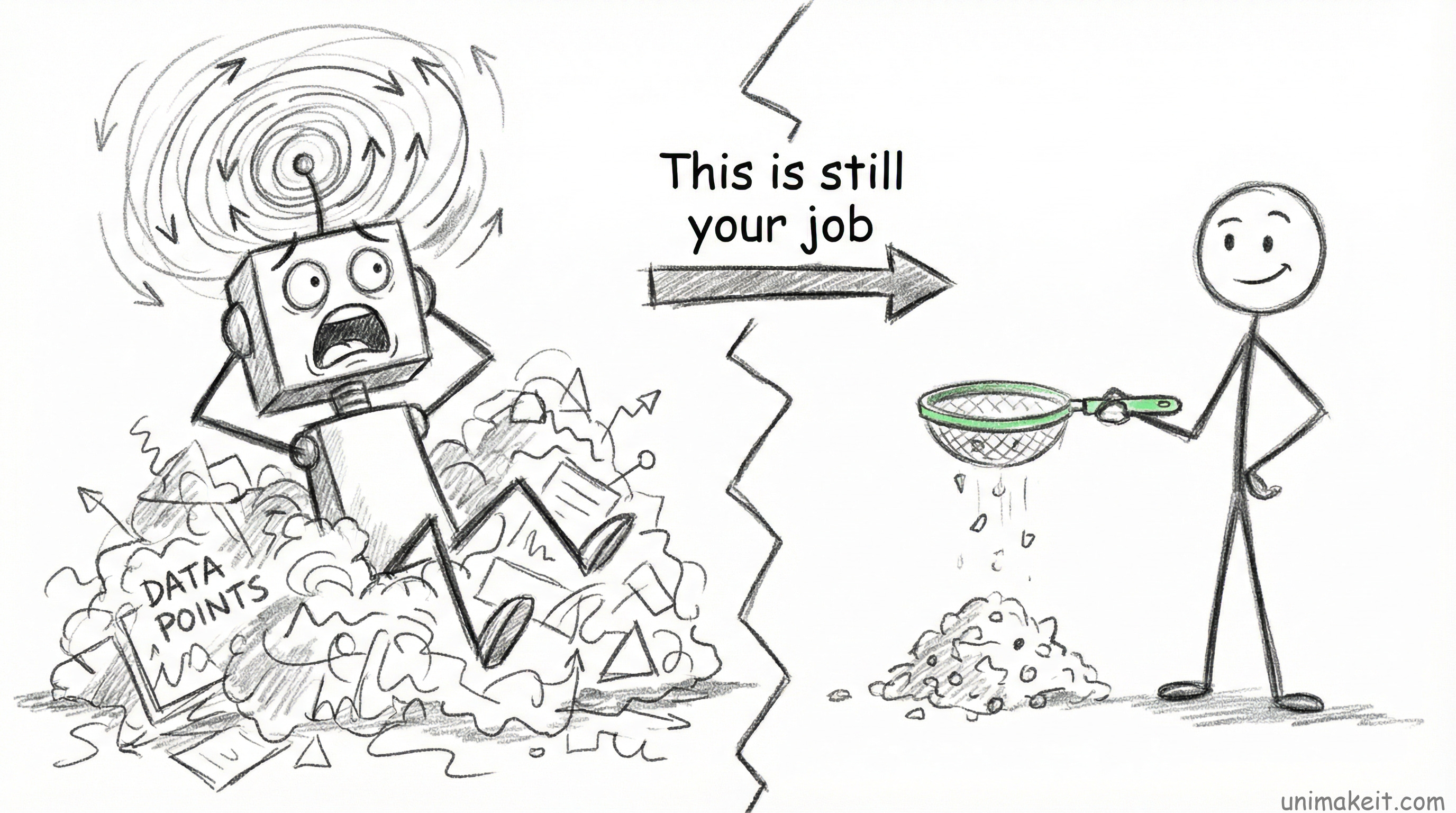
AI can process data faster than you. But it can’t tell you which data to ignore.
That’s still your job.
The Boring Truth: Success Stories Are Lies
Quick question.
What does a successful entrepreneur look like?
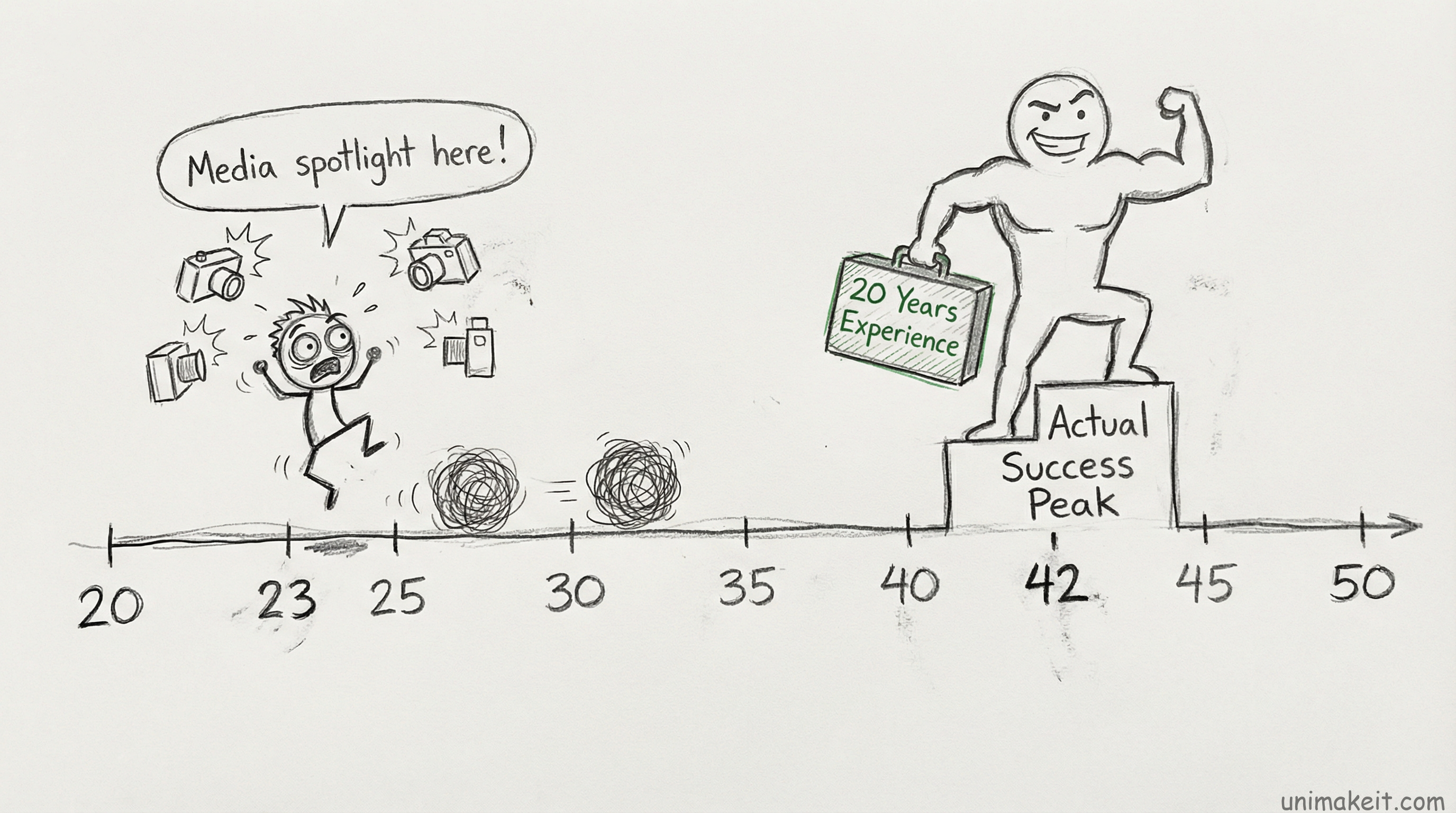
If you said “twenty-something college dropout with a world-changing idea,” congratulations—you’ve been successfully manipulated by media narratives.
The actual data is way less sexy.
Economists analyzed 2.7 million American startup founders.
Average age? 42.
Not 27. Not 30. Forty-freaking-two.
(This is the part where you either feel relieved or personally attacked, depending on your age.)
But wait, there’s more disappointing news!
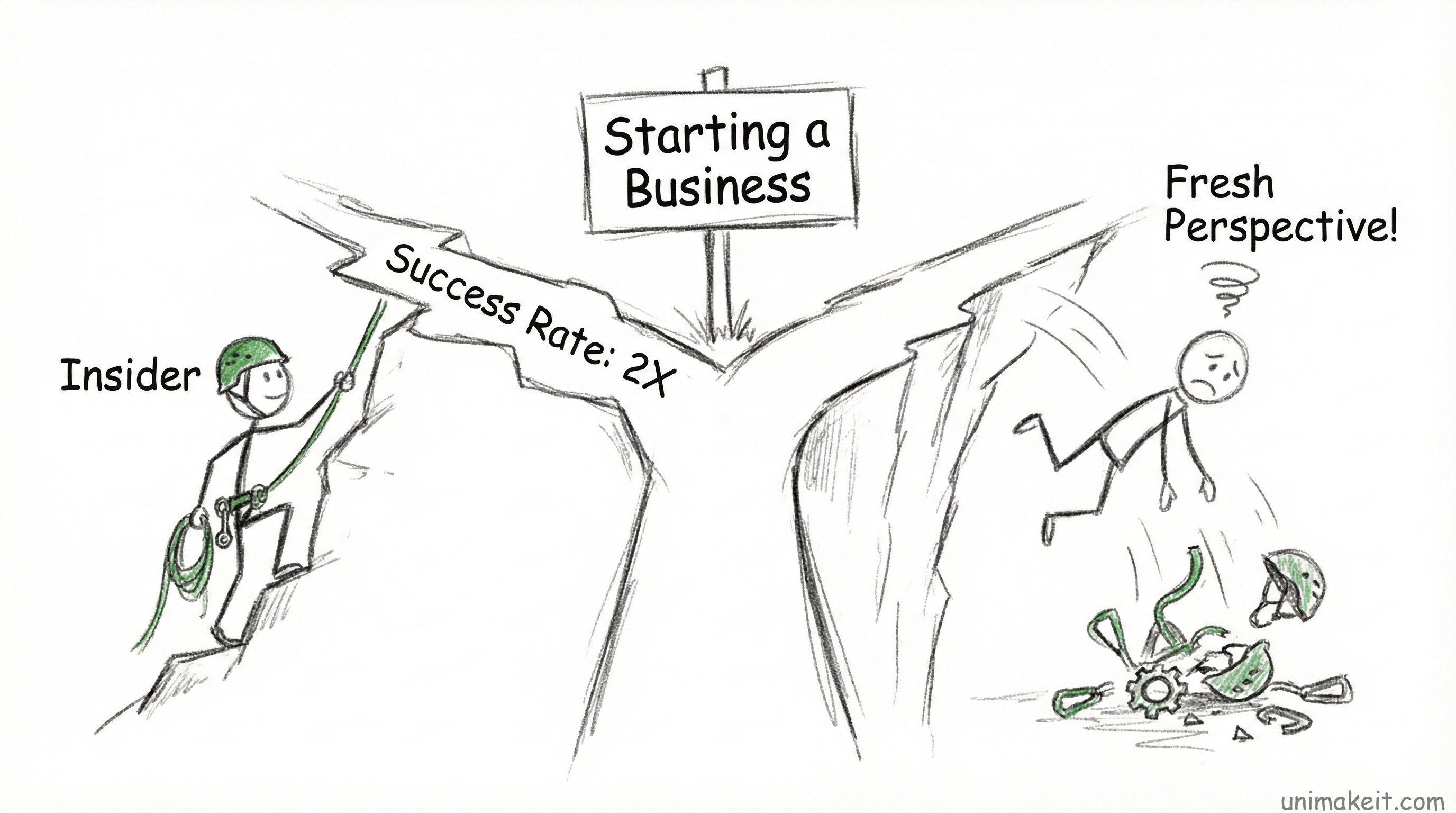
The “outsider advantage” is also a myth.
You know, that inspiring idea that industry outsiders bring fresh thinking while insiders are trapped in old paradigms?
Complete fiction.
If you have direct experience in an industry, your success rate is about double that of outsiders.
The deeper your experience, the bigger your advantage.
Oh, and that whole “fail fast, learn from failure” thing?
Also wrong.
Researchers looked at founder salaries before they started their companies.
The higher your previous salary (meaning: the more successful you already were), the more likely your startup succeeds.
So the actual profile of a typical successful entrepreneur is:
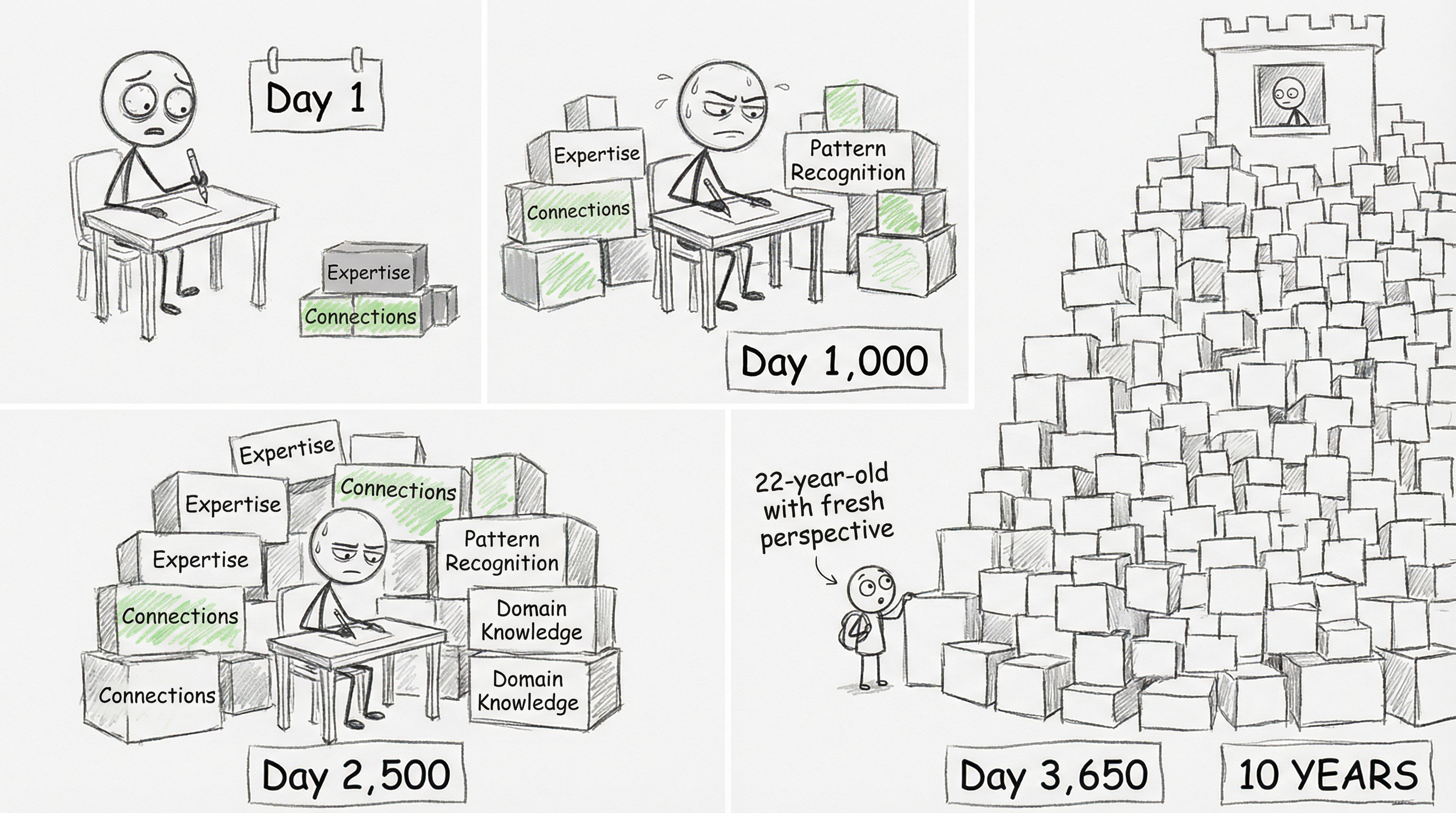
A middle-aged person who spent 15-20 years mastering their industry, climbed to near the top, built deep expertise and connections, then leveraged all that accumulated advantage to start something.
It’s not a movie plot.
It’s not inspiring.
It’s not even interesting.
Which is exactly why nobody talks about it.
But here’s what this means for you, sitting at your desk right now:
Every day you spend building expertise in your field, every relationship you develop, every pattern you learn to recognize—that’s not preparation for your “real” career.
That IS your competitive advantage.
You’re not killing time until you can pivot to something exciting.
You’re building an unfair advantage that gets more valuable every year.
The twenty-somethings with fresh perspectives? They’re not your competition.
They’re playing a completely different game with much worse odds.
Your biggest asset isn’t your youth or your “beginner’s mind.”
It’s the 10,000 hours you’ve already put in that nobody can take away.
The Three Questions: Your New Decision Framework
Okay, so you’ve been building expertise. Great.
Now what?
Whether you’re evaluating a side project, considering a career move, or just trying to figure out where to focus your energy, you need a framework.
Here’s the one that data suggests actually matters:
Before any big bet, ask yourself three questions:
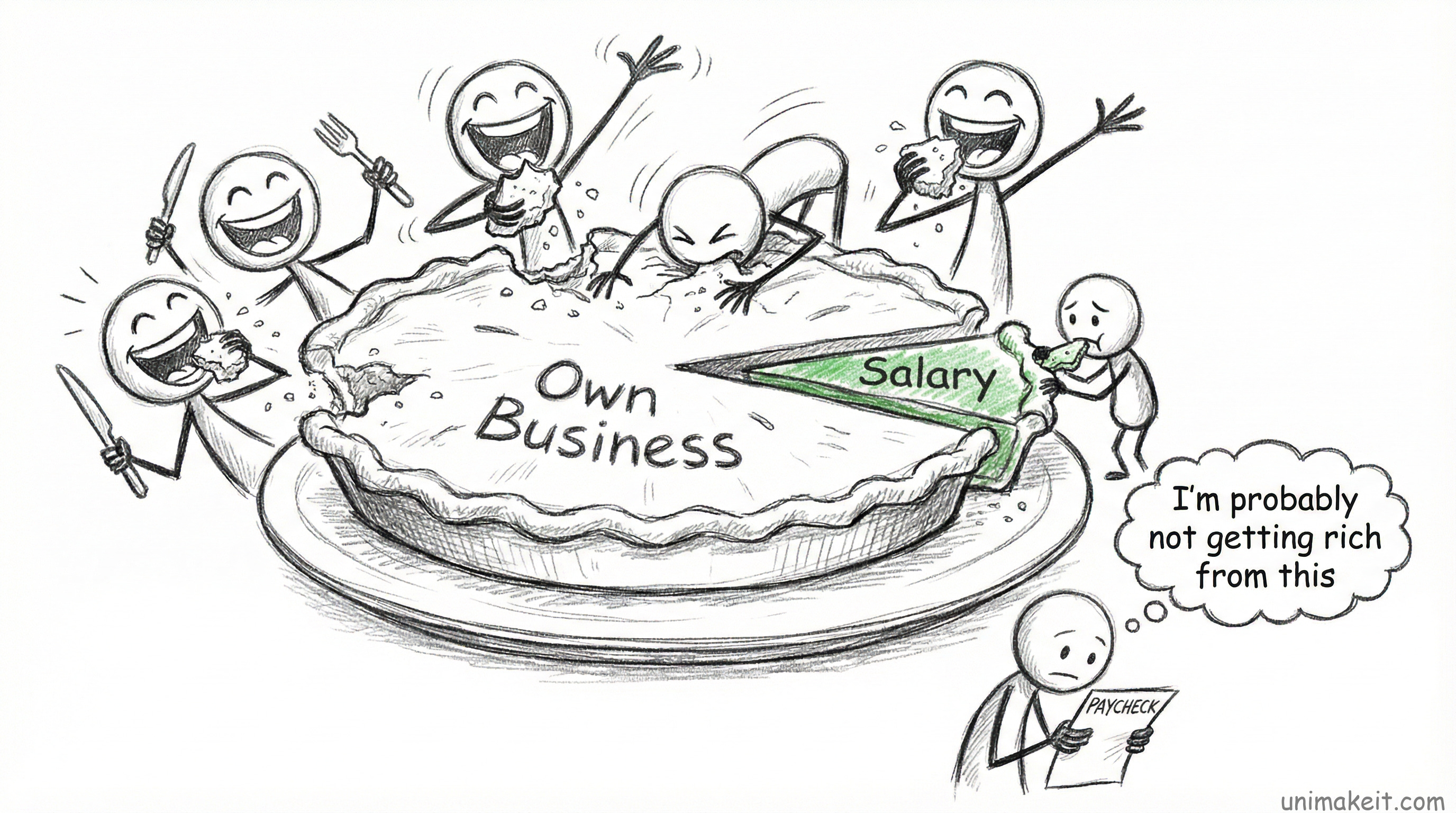
1. Will this give me ownership?
Not necessarily equity (though that’s nice). But will you OWN the outcomes?
Because here’s the harsh truth: You’re probably not getting rich from your salary.
Among the top 0.1% of earners in America, over 80% own a business.
Only 20% got there through salary—and they’re CEOs of giant corporations or famous coaches.
For everyone else, the path to wealth runs through ownership.
Even a small ownership stake in outcomes beats being the best employee.
2. Can I avoid brutal price competition?
This is the question most people skip.
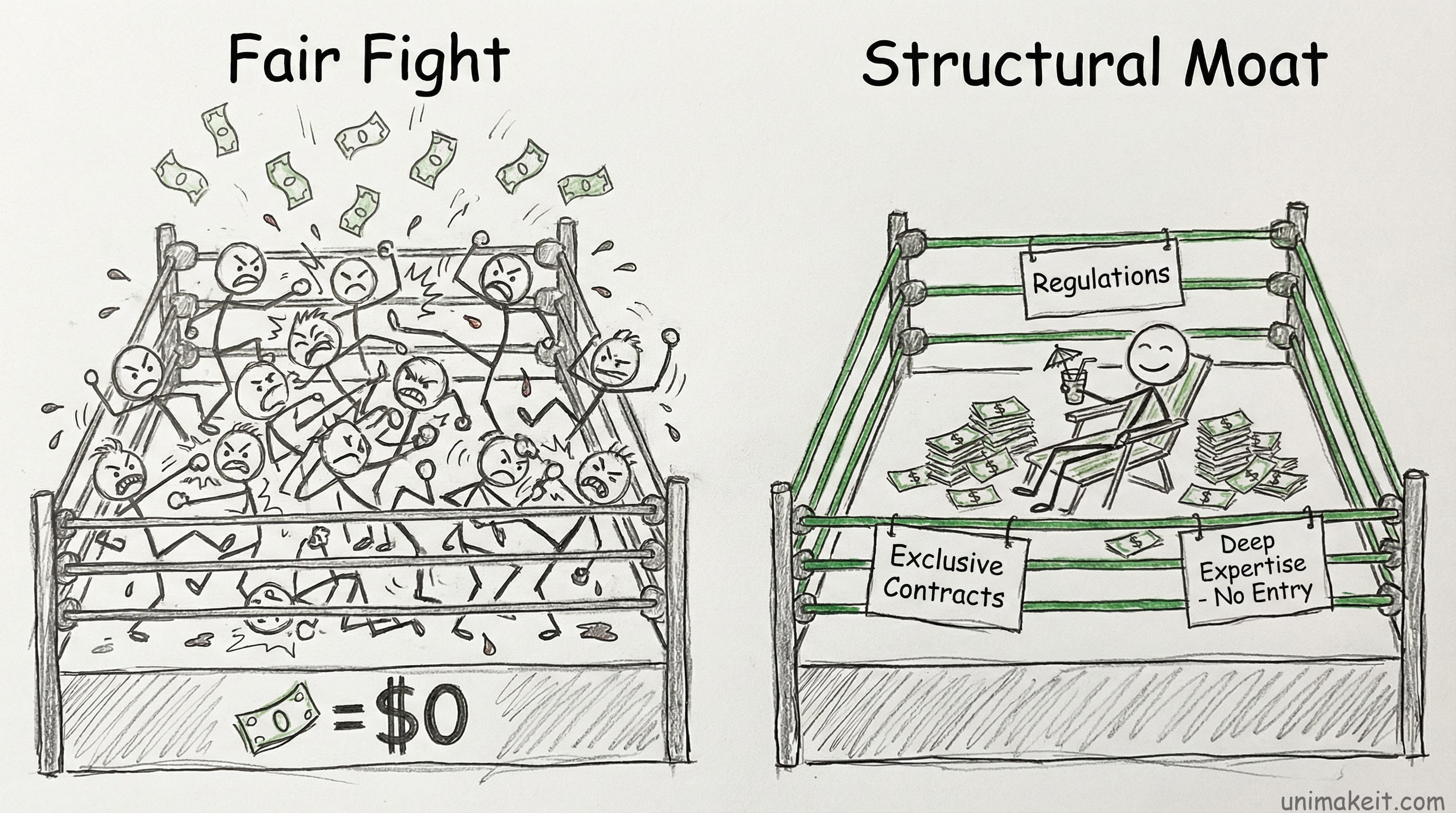
Economists call it the “Zero Profit Theorem”: In any industry with perfect price competition, profit margins get competed down to zero.
Think about it: If anyone can do what you do, and everyone can see what everyone else charges, prices race to the bottom until nobody makes money.
This is why the most successful industries aren’t the ones with the coolest products.
They’re the ones with moats.
Real estate dealerships? Protected by regulations. Wholesale distribution? Exclusive contracts. Specialized consulting? Deep expertise that can’t be comparison-shopped.
You don’t want to be in a fair fight.
You want structural advantages that keep competitors away.
3. Can I avoid winner-take-all dynamics?
This is the counterintuitive one.
Everyone wants to be in the “hot” industry. Tech. AI. Crypto.
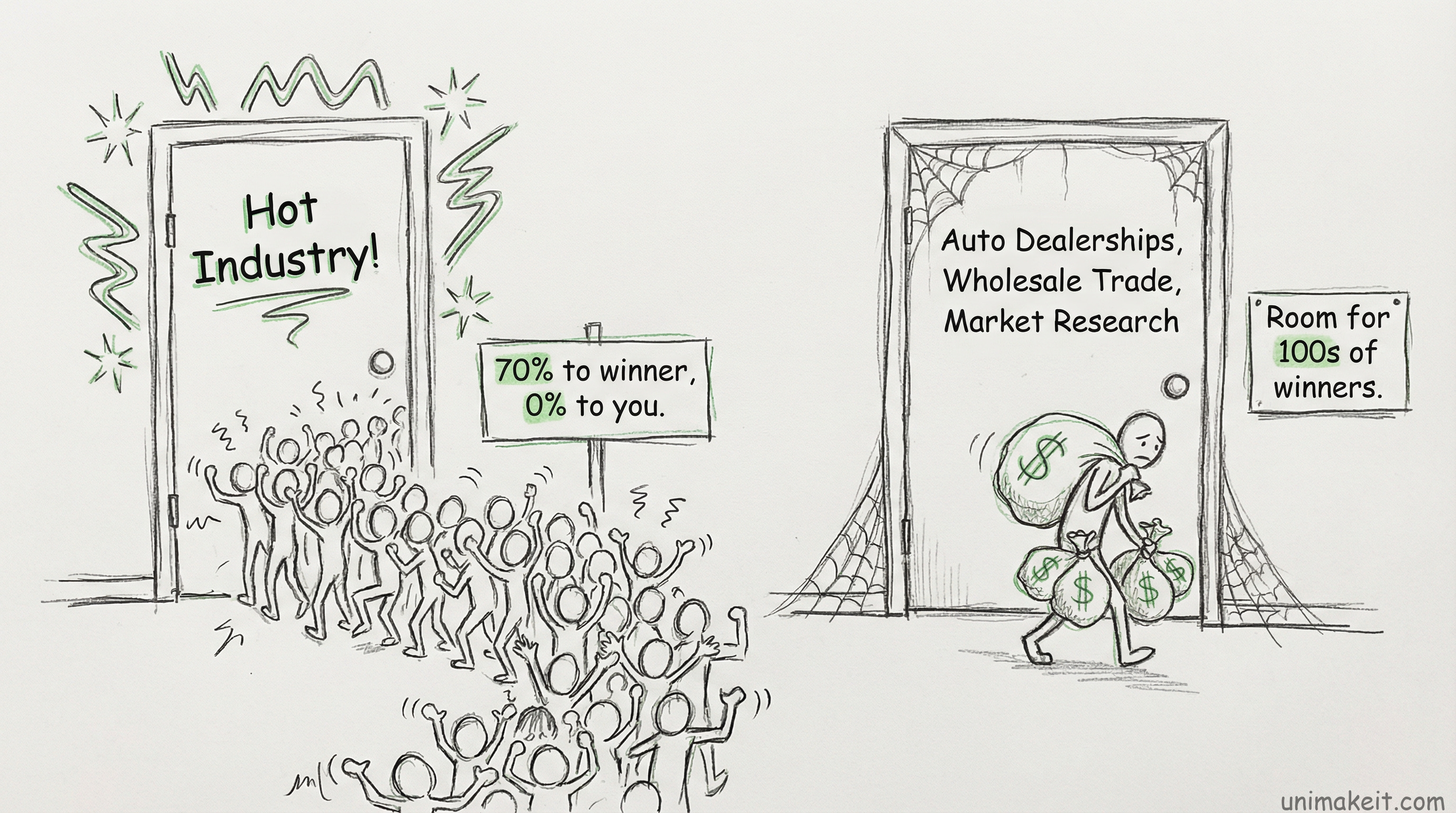
But these industries have a problem: They tend toward 70-20-10 market splits.
First place takes 70%. Second takes 20%. Everyone else fights over 10%.
We see the billionaires who won. We don’t see the thousands of failed startups at the bottom.
The most consistently wealth-generating industries? They’re boring.
Auto dealerships. Market research. Specialized wholesale trade.
Industries where no single player devours the entire market. Where there’s room for hundreds of successful operators.
Here’s how this applies to your career right now:
That exciting pivot to a hot new field? You’re probably walking into a winner-take-all game where you have no accumulated advantage.
That boring deepening of expertise in your current domain? You’re probably building a moat in a space with room for many winners.
Most of us have been trained to chase the exciting opportunity.
Data suggests we should be building boring, defensible advantages in markets with structural protection from competition.
It’s not sexy. But neither is losing.
Manufacturing Luck: The Volume Strategy
Last piece: How do you get luckier?
Because let’s be honest—at some point, success isn’t just about skill or judgment. You need to be in the right place at the right time with the right people noticing.
Physicist Albert-László Barabási analyzed nearly 500,000 artists’ career trajectories.
What predicted success?
Not talent. Not hours practiced. Not number of works produced.
It was the number of different places they exhibited.
Artists who kept showing in the same galleries? Lower success rate.
Artists who constantly moved around exhibiting everywhere? 6 times higher success rate.
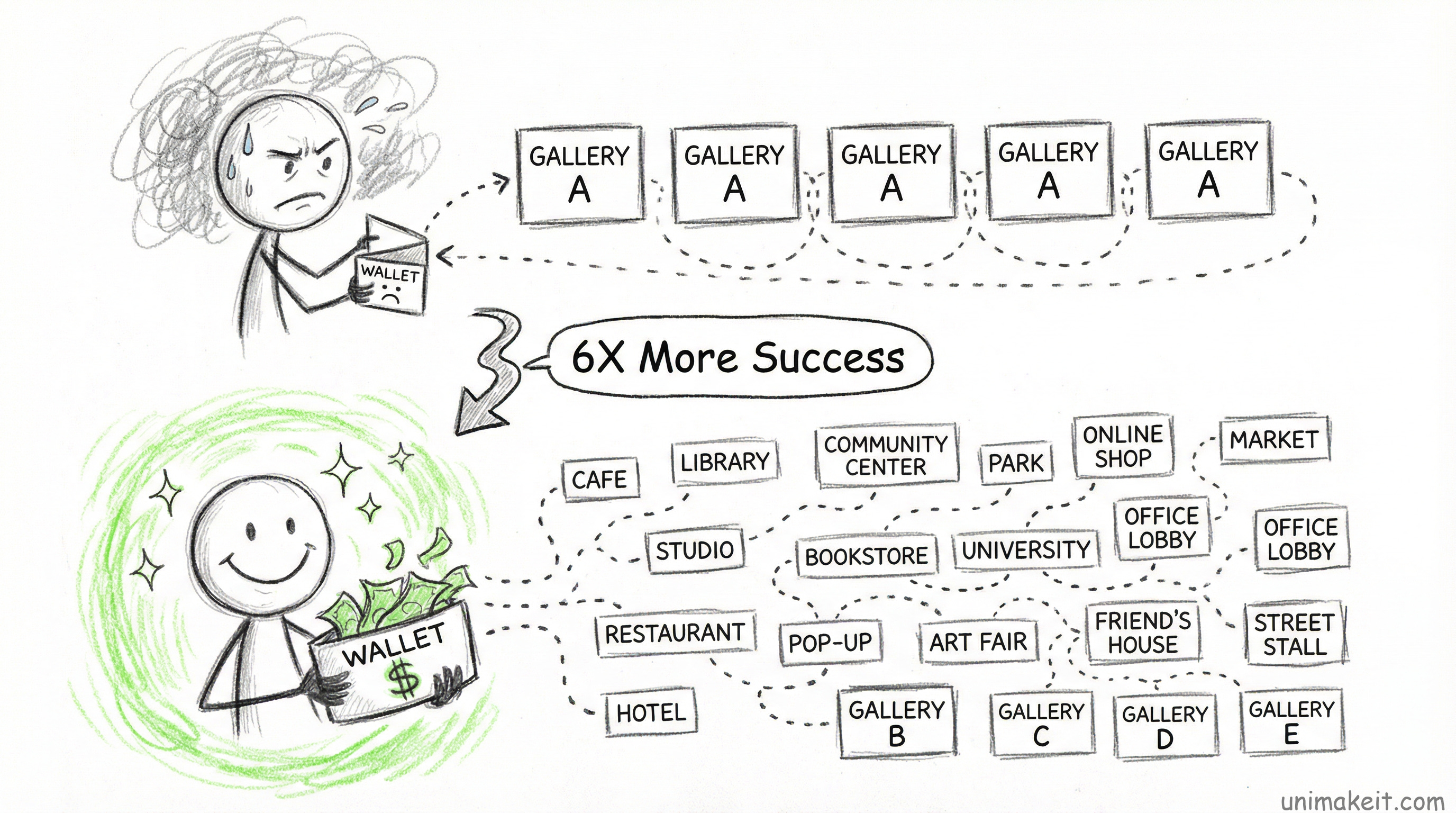
Why?
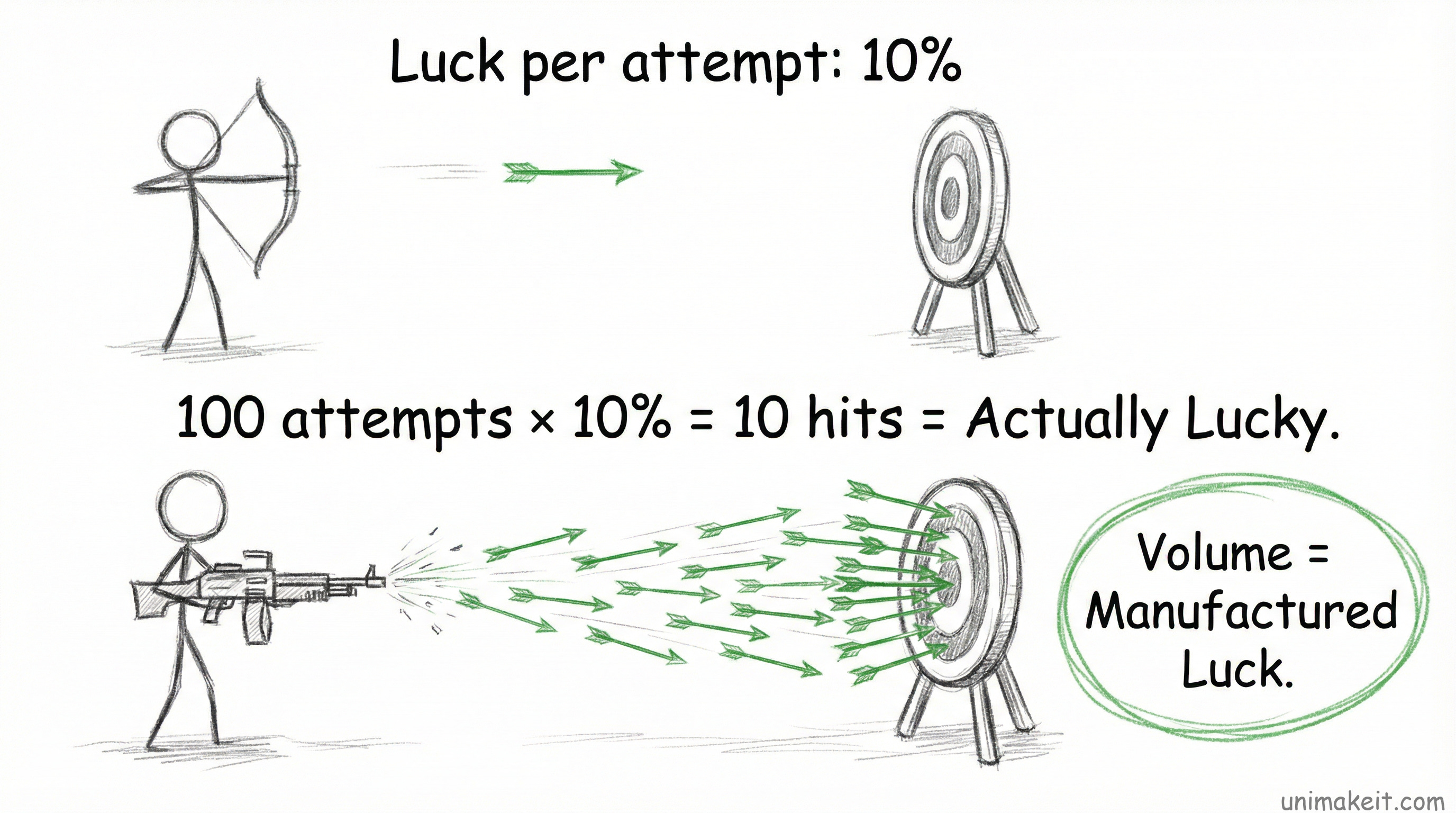
Because luck is a volume game.
You can’t increase your luck per attempt. But you can increase your number of attempts.
More places = more diverse eyeballs = higher chance of meeting your champion.
This applies directly to your career:
That project you’re working on? Don’t just show your boss. Show your boss’s boss. Show the team across the hall. Write about it internally. Present at the company all-hands.
That insight you developed? Don’t keep it in your notes. Write a memo. Share it with your network. Post about it.
That skill you’re building? Don’t hide it until it’s perfect. Use it on visible projects. Volunteer for cross-functional teams.
Here’s the uncomfortable truth: The best idea that nobody sees is worthless.
The mediocre idea that gets in front of 100 people beats it every time.
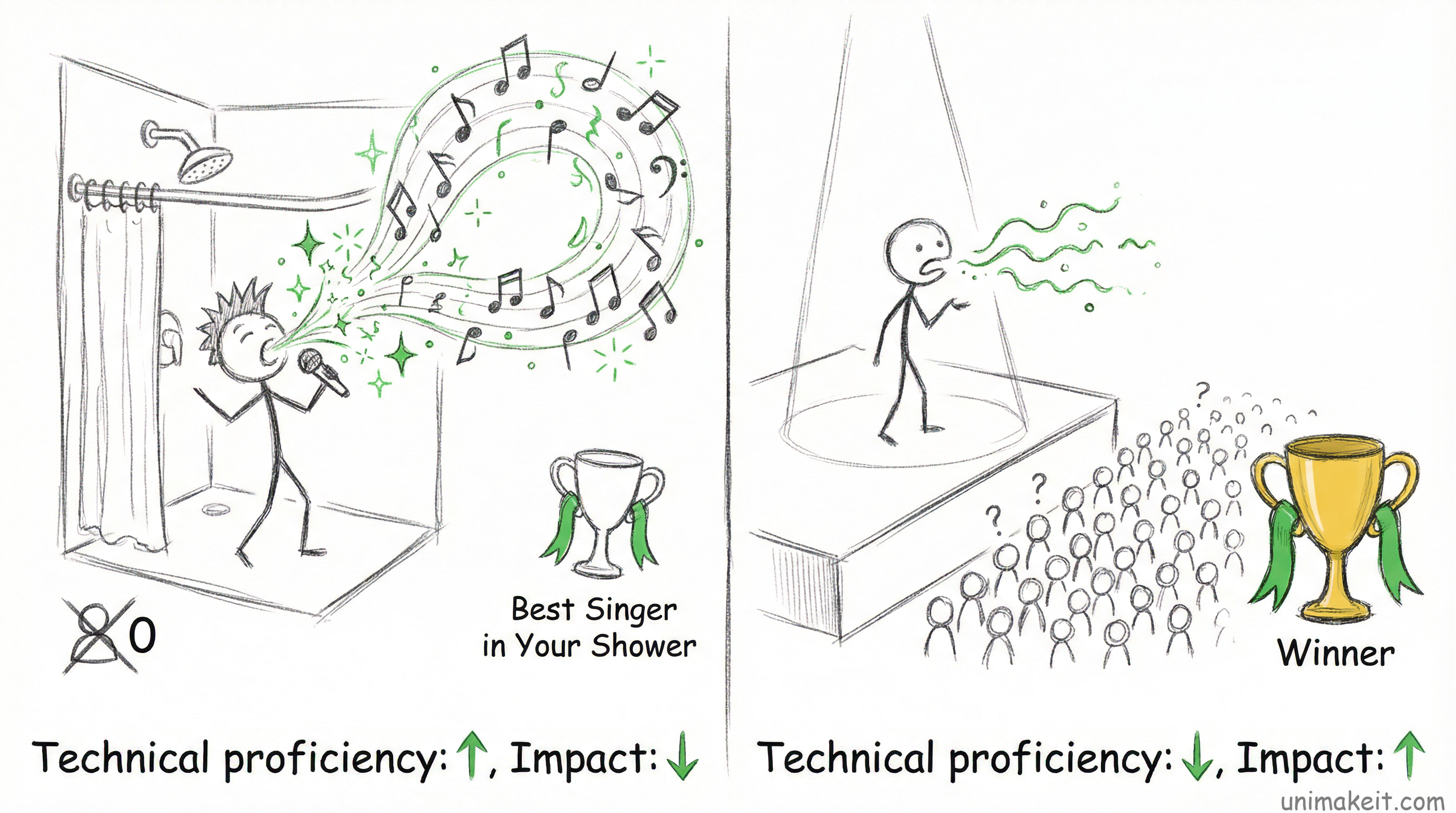
This feels wrong because we’ve been trained to “put our heads down and do good work.”
But doing good work in silence is like being the best singer in your shower. Technically proficient, zero impact.
Research on dating sites proves this brutally:
If “unpopular” people message “popular” people, they think they’ll get ignored.
Actual response rates? 15-35%.
If you message 10 people you think are “out of your league,” odds of at least one reply: 80%.
Most people reject themselves before anyone else gets the chance.
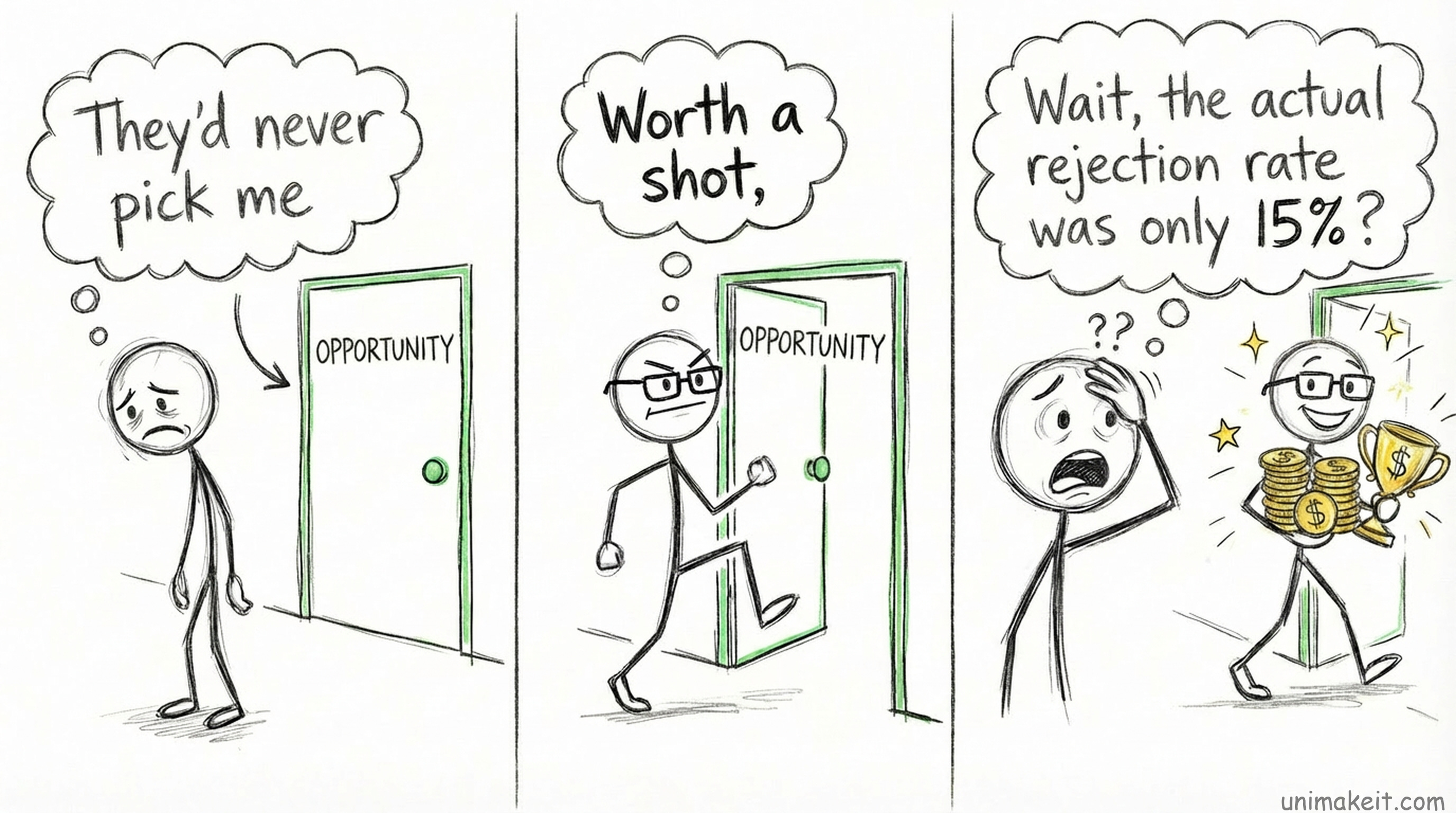
In your career, this looks like:
Not applying because “they’d never pick me.” Not speaking up because “someone smarter probably thought of this.” Not sharing your work because “it’s not ready yet.”
Meanwhile, the programmer who wrote a script to auto-visit 100 dating profiles a day got 20 messages per day and met his future wife on date #88.
Volume works.
So here’s your action item: Pick one thing you’re working on and show it to 10 people this week.
Not people who will definitely care. People who might care.
Not when it’s perfect. Now.
You’re not increasing your luck per attempt.
You’re increasing your surface area for luck.
The Bottom Line:
Your gut evolved to avoid lions, not to optimize career decisions.
Data isn’t perfect. Your life isn’t an average. Sometimes intuition is right.
But when millions of data points all say “your intuition is systematically wrong about this,” maybe listen?
Think of data as a second opinion. Not gospel, but worth considering before you bet your career on a feeling.
Now go increase your surface area for luck.
You’ve got 10 people to bother this week.
Links:
https://sethsd.com
https://www.amazon.com/Dont-Trust-Your-Gut/dp/1526605090


