


Evening, CEO!
I have a confession.
I have never read a “Terms and Conditions” agreement.
Not once.
I scroll. I see the box. I click “I Agree.”
For all I know, I have legally agreed to donate my left kidney to Apple in the year 2034.
The legal world is terrifying. It is a mountain of words that costs $1,000 an hour to understand.
So, when I heard about AI disrupting industries, I assumed the legal profession would be the last to go.
Why? Because lawyers are professional worriers. Their entire job is to think about the worst-case scenario.
Trying to sell an AI hallucination machine to a lawyer sounds like a nightmare. I would rather try to sell a vegan steak to a T-Rex.
But then there’s Harvey.
In February 2025, Harvey was worth $3 billion.
By October 2025, it was worth $8 billion.
It has $100 million in revenue. It is used by almost all of the top 10 law firms in the US.
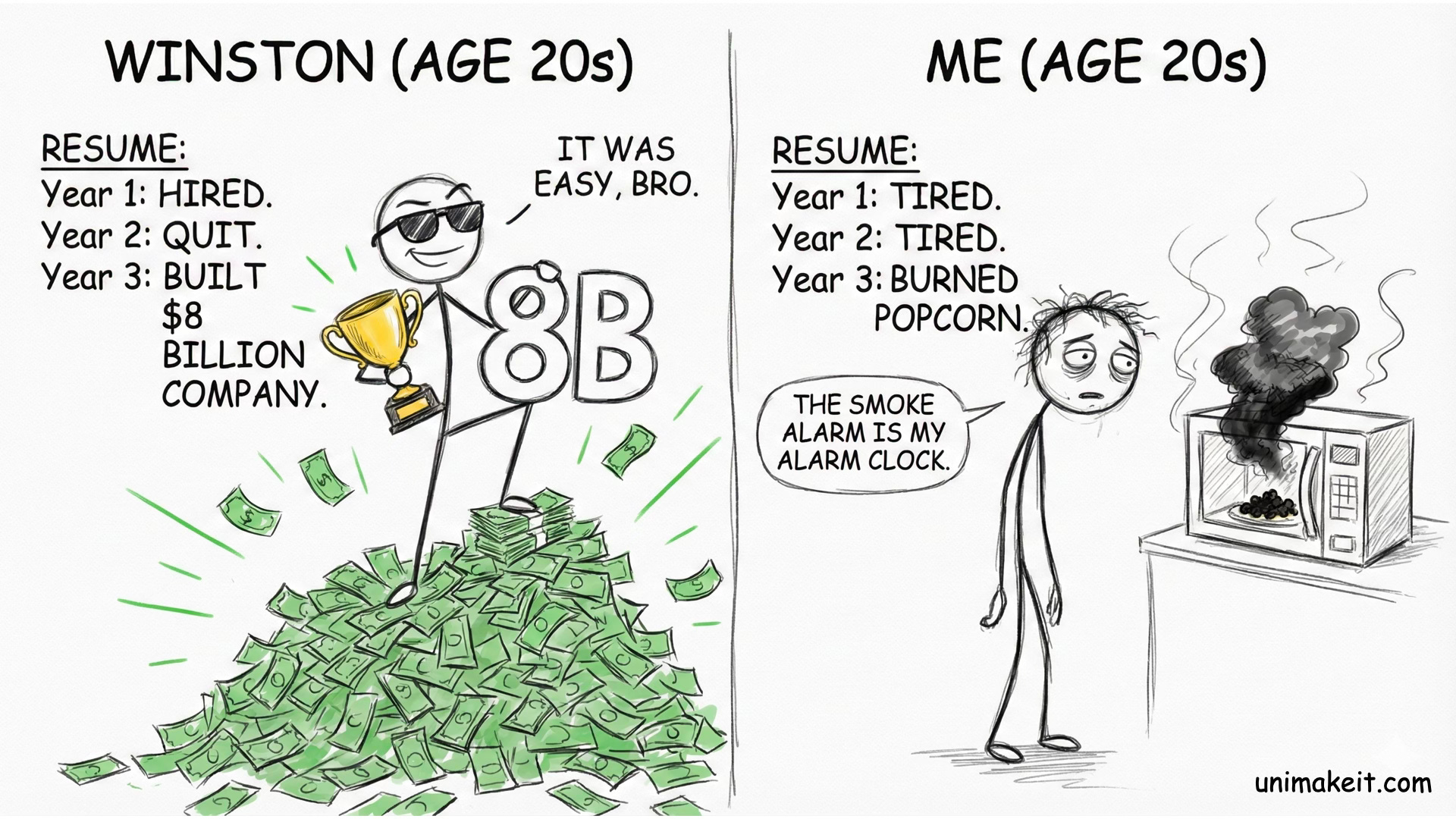
And the guy running it? Winston Weinberg.
Three years ago, he was a junior associate.
He looked at the industry, looked at GPT-3, and said, “I can fix this.”
Here is how he built an $8 billion rocket ship in the world’s slowest industry.
1. Playing on “Hard Mode”
Big Law partners are scary. They care about things like “liability” and “data privacy” and “not ruining their 100-year-old reputation.”
And Winston decided to target the scariest, most prestigious firms first.
His logic was simple:
If you can get the Magic Circle (that’s fancy talk for elite London law firms) to trust you, everyone else will assume you are legit.
If you start at the bottom, the top firms will never look at you.
So Harvey spent time building “ethical walls” and data residency compliance in 63 countries.
While I get stressed updating my laptop, Harvey was building dedicated cloud instances in Germany just to close oneclient.
And it worked.
Once Allen & Overy (a giant firm) said “Yes,” the floodgates opened.
The lesson? Sometimes the shortcut is to take the hardest possible path first.
2. The Sandwich Theory
Legal work is a workflow. But it involves 10,000 documents.
Winston explains Harvey’s product strategy as “Expand and Collapse.”
Expand: First, you build specific AI agents to do the specific, boring ingredients of the job.
One bot extracts clauses. One bot checks for risks. One bot summarizes 500 pages of boredom.
Collapse: Then, you smash them all together into a single button.
You upload a merger agreement. The AI runs ten different background processes. You just see the answer.
It’s like ordering a sandwich.
You don’t want to tell the chef how to slice the tomatoes. You just want the sandwich.
But you can’t make the sandwich unless you know how to slice the tomatoes first.
Harvey figured out the ingredients (the complex legal data) so they could sell the sandwich (the completed workflow).
3. The “Billable Hour” Paradox
Here is the weirdest thing about law firms.
They sell time.
If a lawyer is super efficient and finishes a 10-hour job in 1 hour, they make less money.
It is a business model that punishes efficiency.
If I were a lawyer, I would be rich, because it takes me hours to write a simple article.
So, why would a law firm buy Harvey? Harvey makes them faster. Harvey loses them money.
Winston’s solution is clever.
He tells the firms: “Hey, you know that grunt work you do for free just to win the big clients? The ‘Loss Leaders’? Let me automate that.”
He helps them turn the boring, money-losing work into a flat-fee software product.
Now, the firms are moving from “selling time” to “selling results.”
And Harvey is becoming a “Multiplayer” platform.
Harvey brings the law firms and their corporate bosses (like Microsoft) into the same digital room. They stop emailing attachments and start working side-by-side inside the software.
Once everyone is trapped in the same ecosystem, it is very hard to leave.
4. The Junior Associate Problem
The life of a junior associate is not exactly like an episode of Suits.
They go to law school for three years. They graduate with debt.
Then they spend 80 hours a week in a basement proofreading commas in a spreadsheet.
It is soul-crushing.
But Winston says AI will save them.
Instead of doing the grunt work, the AI does the first draft. The junior lawyer becomes the “editor.”
Of course, this is also a survival test. If you can’t evolve from a “human photocopier” to a “strategic thinker,” you are probably out of a job.
But for the ones who adapt, they get to skip the “Copy Paste” phase of their career and go straight to the “Strategy” phase.
Harvey becomes their tutor. It tells them, “Hey, this clause is risky,” or “This isn’t market standard.”
It’s like having a genius partner sitting on your shoulder, whispering legal secrets.
I wish I had an AI tutor to stop me from buying dumb things on Instagram at 11 PM. But we aren’t there yet.
The Takeaway
We are living in a weird time.
A junior lawyer built a tool that is rewiring a trillion-dollar industry.
He did it by doing the hard things first, ignoring the easy money, and understanding that even lawyers hate doing boring work.
Harvey is now an $8 billion giant.
And me?
I am going to go finally read the Terms and Conditions for my iTunes account.
Just kidding. I’m going to ask Harvey to read it for me.
Links:
https://www.linkedin.com/in/winston-weinberg
https://www.harvey.ai/
https://sequoiacap.com/podcast/training-data-winston-weinberg/
https://research.contrary.com/company/harvey
https://observer.com/2025/09/interview-winston-weinberg-harvey-ai-legal-professional-services/
https://techcrunch.com/2025/11/14/inside-harvey-how-a-first-year-legal-associate-built-one-of-silicon-valleys-hottest-startups/


