


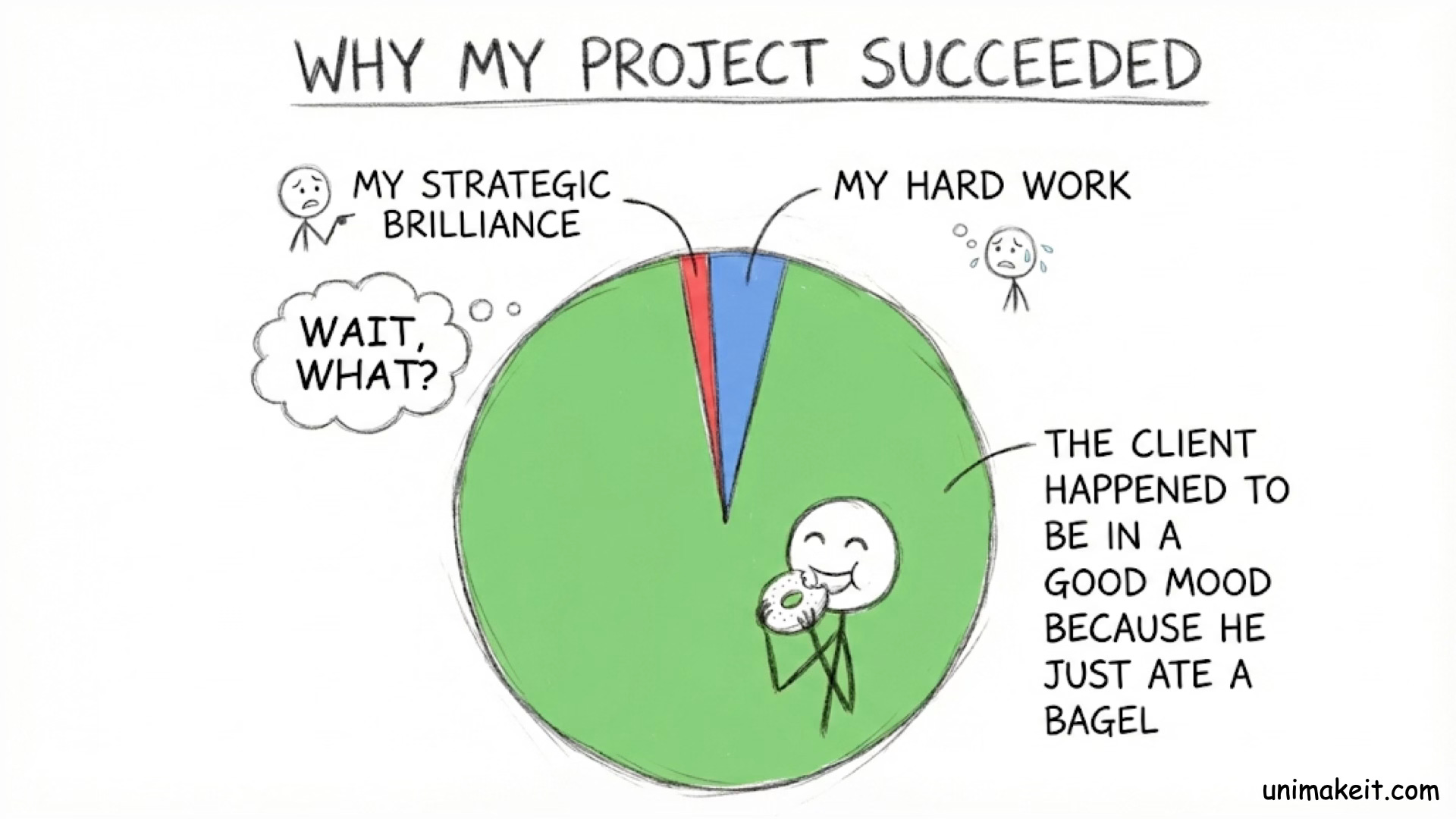
Morning, CEO!
Today, I want to talk about the biggest lie we tell ourselves every single day: Control.
Why are we anxious? Because we desperately want to control the outcome.
Why do we spend hours “researching” a simple decision? Because we think “more information” equals “more control.”
(Spoiler: It does not. Ask my 12 AM self, who is now an expert on 17 different types of air fryers but still doesn’t own one.)
Why do we get so stuck? Because we’re searching for the one single right answer.
But what if the universe’s basic operating system... just doesn’t care about our plans?
1. One Man’s Vacation vs. an Atomic Bomb
In 1926, a guy named Henry Stimson took a 6-day vacation in Kyoto, Japan. He loved the gardens. He loved the temples.
Nineteen years later, in 1945, Stimson is now the U.S. Secretary of War.
The U.S. is deciding where to drop the atomic bomb. Kyoto is high on the target list. It’s a cultural center and an industrial hub.
Everyone agrees. Except Stimson.
Why? No grand military reason. He just... really liked the place from his vacation.
He met with President Truman twice and convinced him to take Kyoto off the list.
One guy’s nice vacation saved an entire city.
Then, the plane sent to bomb the city of Kokura found it was cloudy. So the pilot shrugged and just... went to Nagasaki instead.
A random vacation. A random cloud. Deciding the fate of hundreds of thousands.
This is the truth Brian Klaas points to in his book, Fluke.
The world isn’t “Convergent”—fated to end up in one place.
It’s “Contingent”—wildly, terrifyingly, ridiculously dependent on tiny, random details.
2. The “Control” Illusion We Love
You might say, “Sure, but I can control my stuff.”
This is also what I tell myself. The problem is, we confuse “doing work” with “getting things done.”
What’s “doing work”?
Going to class. Attending meetings. Answering emails.
“Doing work” is a middle step. It has clear rules. It has a human grading system (your boss, your professor, your to-do list app).
If I just follow the rules, I’ll get an A.
This gives me a massive, comforting illusion. It builds three core beliefs:
There is a “right way” to do things.
My job is to just follow the “right way.”
The world is fair, so my reward will match my effort.
(I live by these three beliefs. It’s why I am a very productive, very anxious mess.)
This “doing work” model is the source of our control-freak mindset.
But what’s “getting things done”?
That’s launching the product. That’s building the company.
That’s facing the real world.
The real world has no fixed rules. It’s not linear. It doesn’t care about your checklist.
3. The Universe is Weird
This obsession with “control” and “best” was debunked by biology ages ago.
We used to think evolution was all “survival of the fittest.” The “best” design wins.
Okay. Explain the duck-billed platypus.
It has a duck’s bill, a beaver’s tail, and otter’s feet. It’s a mammal... that lays eggs. And it sweats milk.
What “survival advantage” is this? It looks like a creature designed by a committee after three martinis.
The answer: No advantage. It just... happened.
This is “genetic drift.” Many traits don’t exist because they’re “useful.” They exist simply because they’re not “harmful” enough to kill the animal.
Nature didn’t command the platypus. It just... allowed it.
Let’s go bigger.
66 million years ago, an asteroid wiped out the dinosaurs.
This wasn’t fate. It was just bad luck. The spot it hit—the Yucatán Peninsula—was full of sulfur-rich rock.
This vaporized into a toxic cloud that blocked the sun.
If that asteroid had hit just a few minutes earlier or later, it would’ve landed in the deep ocean. No toxic cloud.
The dinosaurs would probably still be here. And we... wouldn’t.
Our entire human existence is built on one spectacularly unlucky day for some giant lizards.
The world wasn’t “designed.” It was filtered by a billion absurd accidents.
4. So... What Do We Do?
If the world is just a chaotic mess of platypuses and asteroids, should we just give up and watch Netflix?
(Tempting. Very, very tempting.)
No. This is where it gets good.
The goal is to shift from a “Control” mindset to an “Influence” mindset.
Here’s how. Three things.
First: Humility. Admit “I don’t know.”
My brain hates this. It wants to predict the stock market, the weather, and what the cat is thinking.
We’re not managing “uncertainty.” We’re just managing known “risks.”
One study tracked 5,000 kids, then had 160 research teams predict their outcomes at age 15.
The result? Every team’s prediction was about as good as a random guess.
So, just let go of the result. Breathe.
Second: Be an Explorer. Stay open.
If the world isn’t about the “best” answer, but about “allowing” weird stuff, we should act the same way.
Stop trying to find the one “optimal” path. Try stuff. Be weird. Be a platypus.
Third: Connect. Make “Influence” your job.
This is the most important one.
You know how locusts swarm?
If there are just a few, they all fly randomly.
But when the density hits 73.7 locusts per square meter (a weirdly specific number), they all suddenly swarm in one direction.
Why? Because any locust that goes “against the grain” just gets eaten by the others.
There is no leader.
The swarm’s direction is unpredictable. But every single locust is influencing the whole.
We are a much, much more complex swarm.
You can’t control the swarm. I can’t even control my own impulse to eat sliced salami from the bag at 10 PM.
But every tiny thing you do influences it.
The Final Word
Control is an illusion. Influence is your job.
You can’t control the final outcome. So you don’t have to carry that anxiety.
(I’m telling my brain this. It’s skeptical. It’s asking for a spreadsheet.)
But you can choose your next action.
In a connected, chaotic world, no one knows what you’ll do next.
The book’s subtitle is “Why Everything We Do Matters.”
Why?
Because in a world built on random chance... your choice, your action, your tiny push on the swarm... is the only thing that isn’t random.
And that changes everything.
Links:
https://brianpklaas.com
https://www.amazon.com/exec/obidos/ASIN/1668006529


