


Morning, CEO!
So, Is My “Very Useful” Degree Suddenly... Useless?
AI agent is everywhere, and it’s getting good, fast.
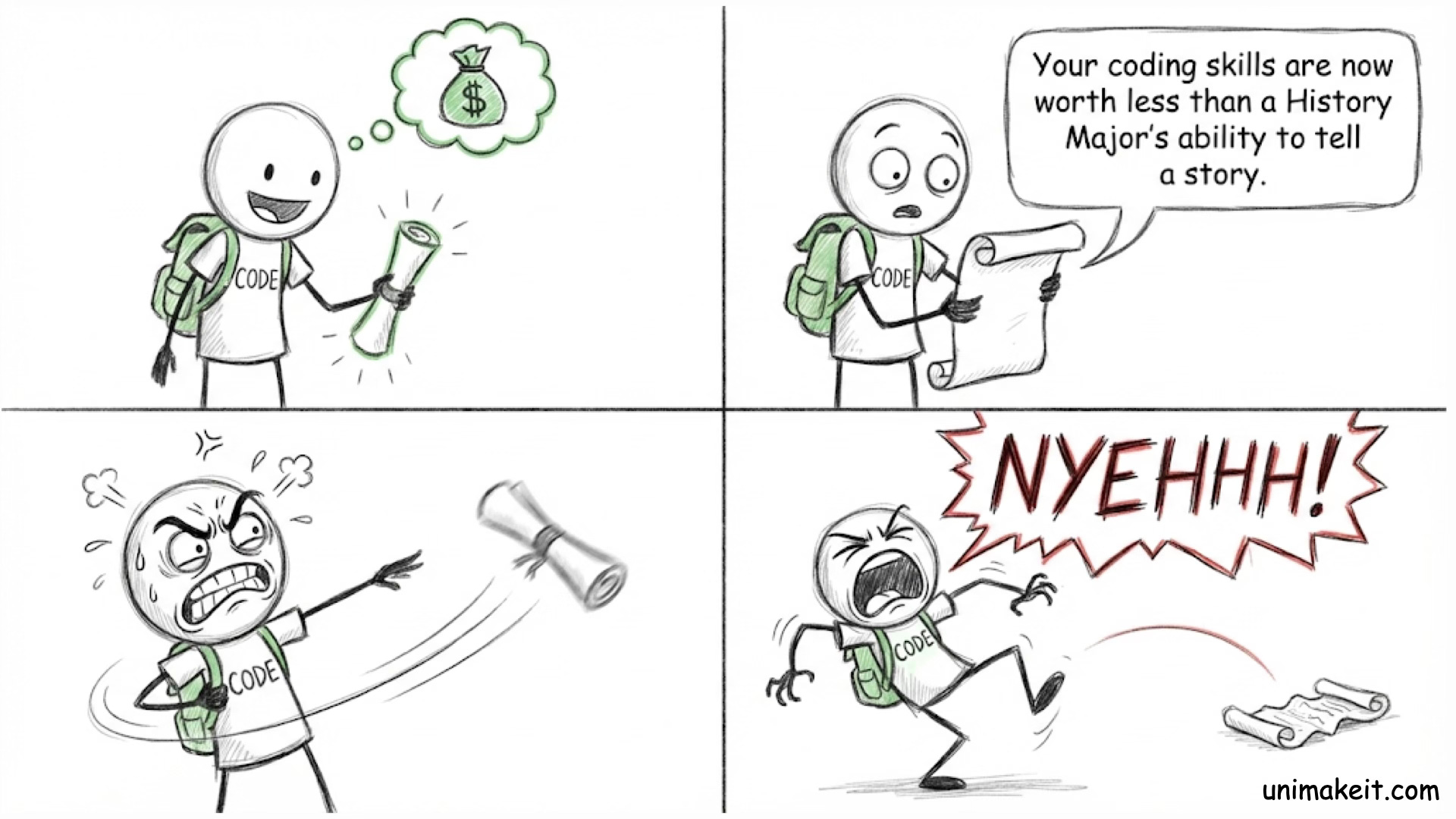
For years, I did everything right. I was the one who “LEARNED TO CODE.”
I am an AI engineer. I speak Python. I am logical, rational, and have a clear, marketable skill. I was safe. I was the future.
And then, AI started getting... really good. At my job.
Meanwhile, all those people who were busy reading 14th-century poetry—the ones I was “quietly superior to”—will be... in demand?
What is happening?
1. Fixed Skills vs. Free Skills (Or, The “Oh Crap” Moment)
I’ve been obsessing over this book by George Anders, You Can Do Anything.
The subtitle is: “All Those ‘Useless’ Liberal Arts Classes Are Secretly a Superpower.”
I probably picked it up just to feel smart. The joke, it turns out, is on me.
His whole point is that the world is being split in two. Not by “hard” vs. “soft” skills.
But by “Complicated” problems vs. “Complex” problems.
A complicated problem is like a jet engine. Or, you know, a Python script. It has thousands of parts, but it’s understandable. It follows fixed rules. You can write a manual (or documentation) for it.
AI loves complicated problems. It eats them for breakfast.
A complex problem is like raising a teenager. Or trying to get two brilliant engineers, who deeply despise each other, to collaborate on a single project.
It’s a messy, unpredictable, human system. There are no fixed rules. The “manual” changes every single day based on who’s hungry or who’s mad at whom.
AI has NO idea what to do with this.
And my “Fixed Skills”—my beautiful, logical code—are for “complicated” problems. The “Free Skills” (Liberal Arts) are for navigating “complex” systems.
The book has this story about an anthropology professor. She shows off her perfectly manicured nails. Students say, “Nice!” Then she cuts them all off and passes the clippings around. Everyone is horrified.
“See?” she says. “The thing itself didn’t change. But the system it was in did.”
My brain immediately goes to work: “How can I optimize the nail-clipping process? What’s the most efficient vector for distribution?”
The “Free Skill” person is asking, “Wait, why do humans find this beautiful in one context and horrifying in another?”
AI can design the shiny nail. It can definitely optimize the clipping.
It is hopelessly confused by the “why.”
I am the person building the nail-optimizer. I am the one AI is coming for. Crap.
2. The “Free Skill” To-Do List
So what is this magical “Free Skill”?
Everyone calls it “Critical Thinking,” which is a term so vague my brain wants to throw a syntax error.
But the book breaks it down into actual, specific skills. Which I appreciate. I like lists. This is now my “Human API” patch list.
1. Exploration
This is the ability to stare into the complete, foggy chaos of a new subject with no instructions and find a thread. This... is not what I do. I’d be the one asking, “What are the exit criteria for the fog? What’s the expected output format for the thread?”
2. Insight
Looking at 500 messy, contradictory data points and having that one “Aha!” moment. (My ‘Aha!’ moments happen when the test suite passes. 147 tests, all green. This ‘messy insight’ doesn’t have a pass/fail state. It’s just... opinions. How do you assert an opinion?!)
3. Choice & Decision
Making a call when you have, at best, 40% of the information you wish you had. I hate this. I want 80% of the data, a clear ‘if/then’ statement, and a predictable outcome. Not “ambiguity” and “gut feelings.”
4. Empathy
The truly baffling skill of realizing that the person who “isn’t using my app correctly” isn’t “stupid”—they just have a completely different, and totally valid, movie playing in their head. (This is hard. My code is objectively correct.)
5. Influence
Taking my logical “Aha!” moment and using words (not just commit messages) to beam it into someone else’s brain so they go “Aha!” too.
Notice what I’m probably bad at on that list? Uh... all of it.
This is a problem.
3. The Apple-Story
This still sounds... fluffy. So here’s the example that really shocked me: Apple.
You’d think Apple, the peak of engineering, would just be a giant pile of MIT grads and elite coders.
Nope. The #1 university that feeds employees to Apple is... San José State.
Which is a totally fine school, but it’s not “elite.”
Why?
Because it’s literally next door.
The students intern there. They do projects with Apple teams. They get coffee with Apple managers.
They are already embedded in the complex system.
This proves two things:
My Fixed Skill (being a top-tier engineer) has a “good enough” threshold. A lot of people can clear it.
The real advantage is the Free Skill—already knowing how to navigate the culture, the workflow, and the messy human relationships.
This means my pristine, elegant, perfectly-optimized algorithm might lose out to someone who... is better at lunch?
So, Now What?
Okay. Deep breaths.
My “Fixed Skills” aren’t useless. They’re just the ticket to the game. They’re the “good enough” threshold.
But AI is making that threshold easier and easier for everyone to reach.
The real game—the one that decides promotions and impact—is the “Free Skill” game.
This means I need to go learn what those 14th-century poetry people know.
I’m clinging to the Scott Adams model: Be in the top 25% of two different things.
Okay, I’m definitely in the top 25% of Python programmers. (Probably. Let’s not check.)
Now I just need to get in the top 25% of... “not being a robot”?
The future doesn’t belong to the person who can code the solution. AI can do that.
It belongs to the person who can define the problem in a way that messy, complex humans actually care about.
This is way harder. Okay, fine. Where do I find that anthropology professor?
Links:
https://www.linkedin.com/in/georgeanders
https://www.georgeandersbooks.com
https://www.amazon.com/You-Can-Anything-Surprising-Education/dp/0316548804


