


Morning, CEO!
The holidays are here. The eggnog is flowing. And the urge to make “Big Plans” for 2026 is currently spiking your dopamine levels.
You are visualizing the new product launch. The home renovation. The total rebrand.
Stop. Put the pen down.
I recently read How Big Things Get Done by Bent Flyvbjerg, and the data is terrifying. 99.5% of big projects fail. They go over budget, over time, or under-deliver.
Before you draft that 2026 roadmap, let’s take a breath. The goal isn’t to be pessimistic; it’s to be strategic.
Let’s look at how to steal the playbook from the successful 0.5%.
1. The “Fat Tail” Monster Under Your Bed
Let’s talk about the Sydney Opera House.
You know it. It’s gorgeous. It looks like white sails catching the wind.
It was also a disaster.
It was supposed to take 4 years and cost $7 million.
It took 14 years and cost $102 million.
That is 1,400% over budget.
In statistics, we usually expect things to follow a “Normal Distribution” (the Bell Curve). Most things are average. Some are a little good, some are a little bad.
But projects follow a “Fat Tail” distribution.
In a Fat Tail, things don’t just go “a little wrong.” If you trip, you don’t scrape your knee; you fall into a black hole.
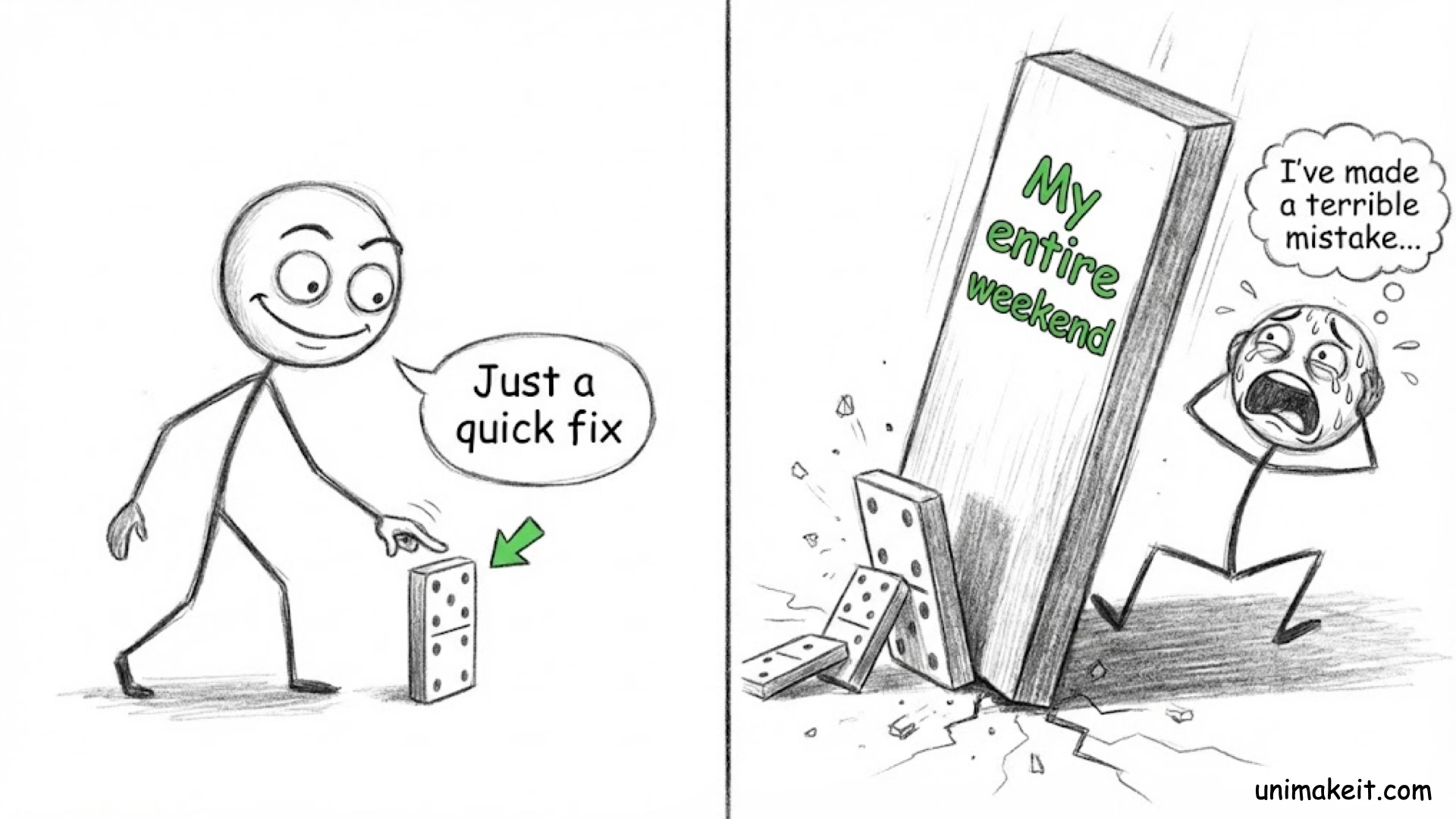
One tiny error—like a cabinet not fitting in your kitchen reno—triggers a domino effect that ends with you rewiring the entire electrical grid of your house.
I am guilty of this. I have an “Optimism Bias” the size of Texas.
I think saying “yes” to a coffee chat three weeks from now is a great idea. When the day comes, I stare at my calendar like it’s a bomb defusal timer, wondering why Past Hannah hates Future Hannah so much.
I think I can record, edit, and publish a YouTube tutorial in one day. Reality: I spend six hours fixing the lighting and then give up because my voice sounds weird.
We assume we are in the safe middle of the Bell Curve. We are not. We are dancing on the edge of the Fat Tail cliff.
2. Think Slow, Act Fast (The Pixar Method)
Humans have a bug in our code: We love Action.
We want to start digging. We want to start coding. We want to start recording the podcast.
“Planning” feels like “Stalling.”
But the 0.5% of projects that actually succeed? They do the opposite. They Think Slow and Act Fast.
Look at Pixar.
Pixar doesn’t just write a script and animate it. That’s the Sydney Opera House method (start building before you know if the roof stays up).
Pixar makes the movie. Then they realize it sucks. So they throw it out and make it again. And again. They make the movie roughly eight times on cheap storyboards before they render a single pixel of expensive 3D animation.
Frank Gehry, the architect behind the Guggenheim Bilbao, does the same thing.
He builds hundreds of cheap cardboard models. He simulates the building in software thousands of times. He crashes the plane in the simulator so he doesn’t crash it in real life.
When they finally broke ground on the Guggenheim? It was boring. Everything went exactly to plan because they had already “built” it virtually.
My default mode is “Fire, then Aim.”
I get a vague idea for an article. I sit down and type 3,000 words of pure stream-of-consciousness.
Then I read it. It’s a mess. It has no point. I have to throw the whole thing away.
I wasted an hour typing because I was too impatient to spend five minutes outlining.
3. Don’t Be a Hero, Be a Copycat
We all want to be unique. We want to be “disruptors.”
But when it comes to execution, being unique is expensive.
The Empire State Building was the tallest building in the world for 40 years. Do you know how long it took to build?
13 months.
That is insane. It takes longer than that to fix a pothole in my neighborhood.
How? Modularity.
The builders didn’t try to invent a new way to build a skyscraper. They treated the building like a giant Lego set.
They realized the building wasn’t one giant, unique monster. It was just a bunch of identical floors stacked on top of each other. They mastered the process of building one floor, then just hit “Ctrl+C, Ctrl+V” 102 times.
They used “Reference Class Forecasting.”
Instead of looking inward and saying, “I’m special, I can build this faster,” they looked outward. They looked at the data of other steel buildings.
This is the hardest pill for me to swallow.
When I estimate a project, I use the “Inside View.” I look at my skills, my coffee intake, and my enthusiasm. “I can finish this Coursera certification this weekend!”
The “Outside View” looks at the data. It asks: “Hannah, how many courses are currently sitting in your browser tabs, 8% complete?”
The answer is seven. The data says I will watch the intro video and then never log in again.
The data doesn’t lie. My ego does.
So for your next project:
Break it into Legos (small, repeatable chunks).
Find someone who has done it before.
Copy their timeline.
To recap:
Your brain loves the dopamine hit of the “start.” It’s addictive. But your success depends on the boring safety of the “plan.”
Be the boring architect first, so you can be the fast builder later.
Think slow. Simulate the failure before you spend the money.
Act fast. Once the plan is bulletproof, execute like a Lego master.
Fear the Fat Tail.
Links:
https://dk.linkedin.com/in/flyvbjerg
https://www.dangardner.ca
https://www.amazon.com/How-Big-Things-Get-Done/dp/0593239512


