


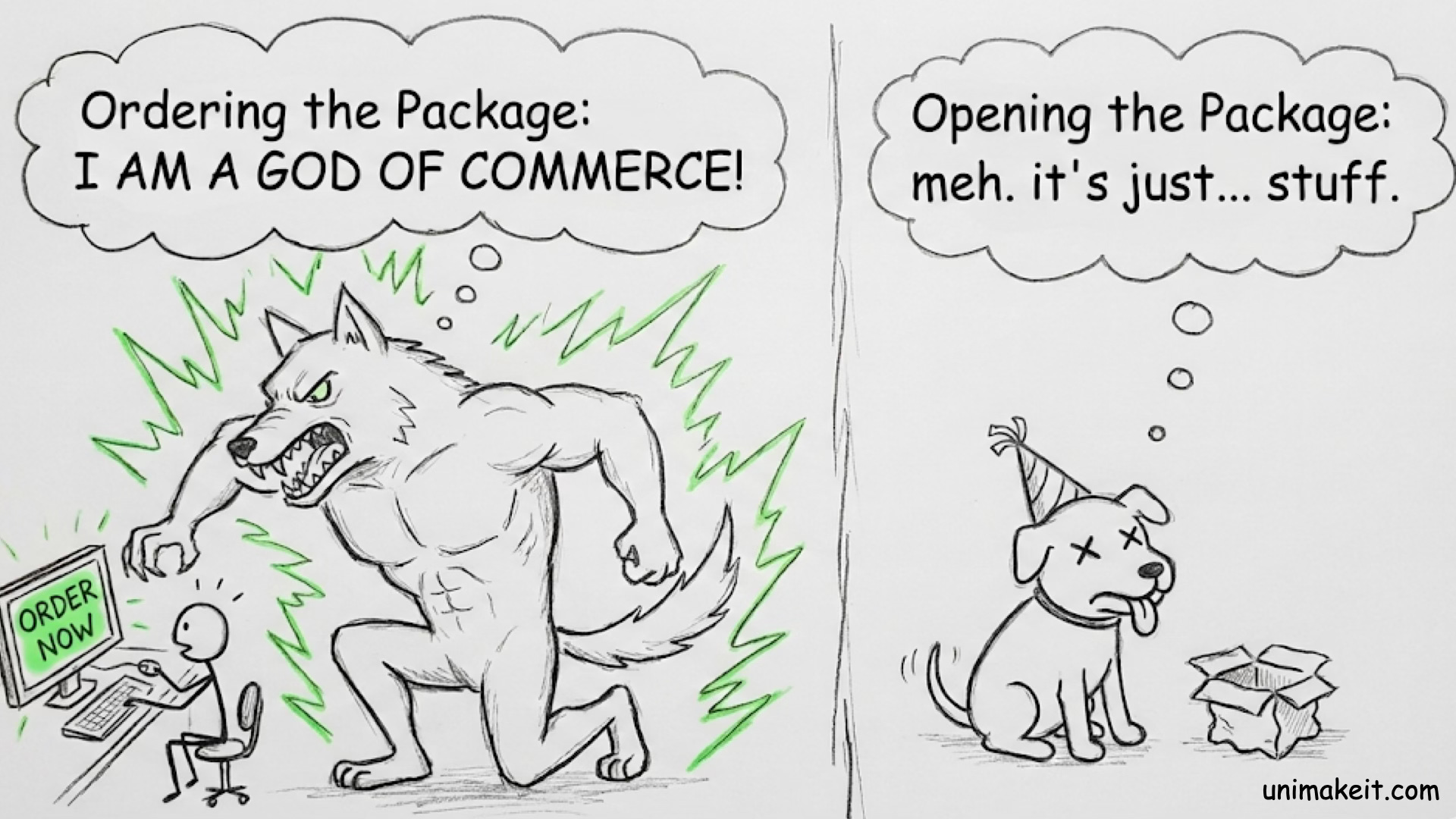
Morning, CEO!
I’m writing this while staring at a pile of laundry I was supposed to fold three days ago.
Also, I just ate a donut.
Before I ate the donut, my brain said: “Hannah, listen. If you eat this donut, you will achieve a state of permanent, transcendent bliss. All your anxieties about the future? Gone. Just sugar and peace.”
So I ate the donut.
It took about 45 seconds.
Now I just feel sticky. And the laundry is still there. And my anxiety is back, but now it’s covered in glaze.
Why am I like this? Why are we like this?
I recently re-read Robert Wright’s book, “Why Buddhism is True.”
Don’t worry. It’s not a book about crystals or levitating monks. Robert Wright is a science guy. An evolutionary psychology guy.
He explains why the software running inside our heads—code written by Natural Selection millions of years ago—is actually designed to make us miserable.
Here is what I learned (and why I’ll probably eat another donut later).
1. Evolution is a Troll
In Buddhism, there’s this concept called Dukkha.
People usually translate this as “Suffering.” Which sounds super dramatic.
But a better translation is “Unsatisfactoriness.”
It’s that feeling of “Meh” that hits you five minutes after you get the thing you desperately wanted.
Here is the problem:
Natural Selection does not care if Hannah is happy.
Natural Selection only cares if Hannah passes on her genes to the next generation.
To get me to do that (and stay alive long enough to do it), Evolution installed a very specific operating system in my brain.
Rule 1: “Doing things that help survival (eating, social status, romance) will feel AMAZING.”
Rule 2: “The amazing feeling will last approximately 0.3 seconds.”
Rule 3: “You will forget Rule #2 immediately.”
This is the trap.
My brain focuses on the anticipation of the reward.
The dopamine hits me before I eat the donut. It hits me when I see the glowing “Hot Now” sign.
Once I actually have the donut? The dopamine vanishes.
Why? Because if the satisfaction lasted forever, I’d never get off the couch to find more food. I’d just sit there, blissed out on one crumb of food from 1999, and eventually starve.
So Evolution designed me to be a hamster on a wheel. I run toward the carrot, I get a tiny nibble, the carrot moves, and I keep running.
I am essentially a biological robot designed to be perpetually dissatisfied.
Cool. Thanks, Evolution.
2. Meditation is just refusing to board the “Crazy Train”
So, how do we stop the hamster wheel?
Wright suggests Meditation.
Now, whenever I try to meditate, it looks peaceful from the outside.
Inside? It’s a rave. A rave hosted by a squirrel.
“Focus on your breath, Hannah.”
“Okay, breathing... in... out...”
“Did I reply to that email?”
“I wonder if penguins have knees.”
“I should Google penguin knees right now.”
“NO. FOCUS ON THE BREATH.”
Wright says this chaos is normal.
The brain isn’t one CEO making decisions. It’s a parliament of yelling modules.
There is a Fear Module. A Hunger Module. A “What Do People Think Of Me” Module.
They are all fighting for the microphone.
Usually, when the Fear Module yells, “Oh my god, you said something stupid in a meeting four years ago!” I immediately obey.
I engage with the thought. I spiral. I ride that train all the way to Panic Town.
Meditation is the practice of standing on the train platform.
The train (the thought) pulls into the station.
Normally, I jump on the train without looking.
Mindfulness is realizing: “Oh, look. That’s the ‘I’m Not Good Enough’ Express. It arrives every Tuesday at 2 PM. I’m just going to watch it sit there.”
Eventually, if you don’t get on, the train leaves.
I am not good at this yet. I usually end up on the train, halfway to another country, before I realize I was supposed to be watching my breath.
But occasionally? I stay on the platform. And it feels like a superpower.
3. My “Essence” Detector is Broken (Emptiness)
This is the trippy part. “Emptiness.”
It doesn’t mean nothing exists. It means things don’t have the “story” we attach to them.
Wright gives an example of a chainsaw buzzing outside. It’s annoying. It makes you angry.
But if you strip away your reaction, it’s just sound waves. Vibrations in the air.
I have this problem with my alarm clock.
When my alarm goes off, I don’t just hear a sound. I hear Evil.
I feel like the alarm clock personally hates me. It has a malicious “essence.”
But that “essence” isn’t in the clock. It’s in my head. I am painting “evil” onto a plastic box that cost $12 on Amazon.
This is “Form is Emptiness.”
We walk around wearing 3D glasses that overlay emotional labels on everything.
That person cutting me off in traffic? Villain.
That pile of laundry? Evidence of my failure as an adult.
That donut? Salvation.
None of that is real. It’s just a car. Just clothes. Just fried dough.
The world is empty of the stories I project onto it.
The Takeaway
So, why does this matter?
Because I spend 90% of my life controlled by an outdated algorithm.
I spent my 20s (and let’s be honest, my 30s, and now my early 40s) thinking:
“Once I get that job / finish that project / meet that person, THEN I will be happy.”
That is the illusion.
The finish line is a hologram projected by my genes to keep me moving.
Realizing this doesn’t fix everything. I’m still going to eat donuts. I’m still going to get annoyed when the Wi-Fi is slow.
But at least now, when I’m spiraling, I can pause and say:
“Okay, Hannah. This isn’t reality. This is just the squirrels in your head fighting over the microphone.”
And sometimes, just knowing that is enough to let the train pass by.
Now, I have to go Google if penguins have knees.
(Spoiler: They do. They’re just hidden inside their feathers. You’re welcome.)
Links:
https://x.com/robertwrighter
https://www.amazon.com/Why-Buddhism-True-Philosophy-Enlightenment/dp/1439195455


