


Morning, CEO!
I’m currently staring at my bank account and trying to calculate if I can afford the “good” coffee beans this week.
Usually, this leads to a spiral about inflation, the economy, and why my savings account looks like it’s on a diet.
But I recently read Life after Capitalism by George Gilder, an 86-year-old futurist who basically told me my anxiety is mathematically incorrect.
He argues we’re measuring wealth with the wrong ruler. So, let’s upgrade your operating system.
1. Your Money is actually Frozen Time
I used to think money was just... money. Green paper. Digital numbers. The stuff that keeps the roof over my head from magically disappearing.
But Gilder says: Money is Time.
Here’s the logic: In 1986, a Thanksgiving dinner cost $30. Today, it’s over $50. My brain screams, “I am poorer!”
But wait. In 1986, the average person had to work 33 minutes to earn that dinner. Today? Only 23 minutes.
The price went up in dollars, but down in hours.
This blew my mind.
We usually measure our careers by the number on the paycheck. But as the boss of your own career, you need to measure in Time Prices.
If you use an AI tool to automate a report that used to take you four hours, and now it takes 15 minutes, you didn’t just “save time.” You literally printed wealth.
You lowered the “time price” of your output.
Most people are trying to hoard cash. But cash inflates and rots.
Smart operators hoard time.
If you’re spending 10 hours a week on email, you are essentially lighting your wealth on fire. The goal isn’t just a higher salary; it’s reducing the minutes it takes you to deliver value.
2. Stop Selling Atoms, Start Selling Recipes
Let’s talk about IKEA furniture.
If I buy a flat-pack bookshelf for $100, I possess $100 of ‘wealth.’
Then, I try to assemble it. I lose a screw. I put the back panel on upside down. The whole thing leans to the left like it’s drunk.
Technically, the atoms are all still there. The wood, the metal, the plastic—nothing physically left the room.
But the value dropped from $100 to $0.
Gilder points out that a crashed Ferrari has the exact same molecular weight as a brand-new Ferrari. The only difference? Knowledge.
The “knowledge” of how the parts fit together was destroyed in the crash.
We are stuck in a “materialist” mindset. We think wealth is stuff. Resources. Gold. Silicon.
But silicon is just sand. It’s dirt. It’s worthless until we etch knowledge onto it to make a chip.
As a professional, are you trying to sell your “stuff”? Your hours? Your physical presence?
That’s a losing game. The market for “warm body in a chair” is crashing.
You need to sell the recipe.
Your value isn’t that you know how to type; it’s that you know what to type.
When you use AI, you are the Chef. The AI is just the sous-chef chopping the onions. If you don’t have the “knowledge” (the taste, the judgment, the strategy), all the AI will do is help you create a bigger pile of burnt salmon faster.
Wealth is knowledge. Hoard that instead.
3. If You Didn’t Faceplant, You Didn’t Learn
I am a creature of extreme habit. My comfort zone is heavily fortified, temperature-controlled, and has excellent Wi-Fi.
This means I hate surprises.
My ideal day is a day where everything happens exactly as I predicted it would in my Google Calendar.
But Gilder has a bone to pick with my comfort zone. He says: Information is Surprise.
Think about it. If I tell you “1+1=2,” I have given you zero information. You already knew that. It’s redundant.
But if I tell you, “Hey, the project you thought was safe just imploded,” that is information.
It’s unwanted, sure. But it’s high-signal.
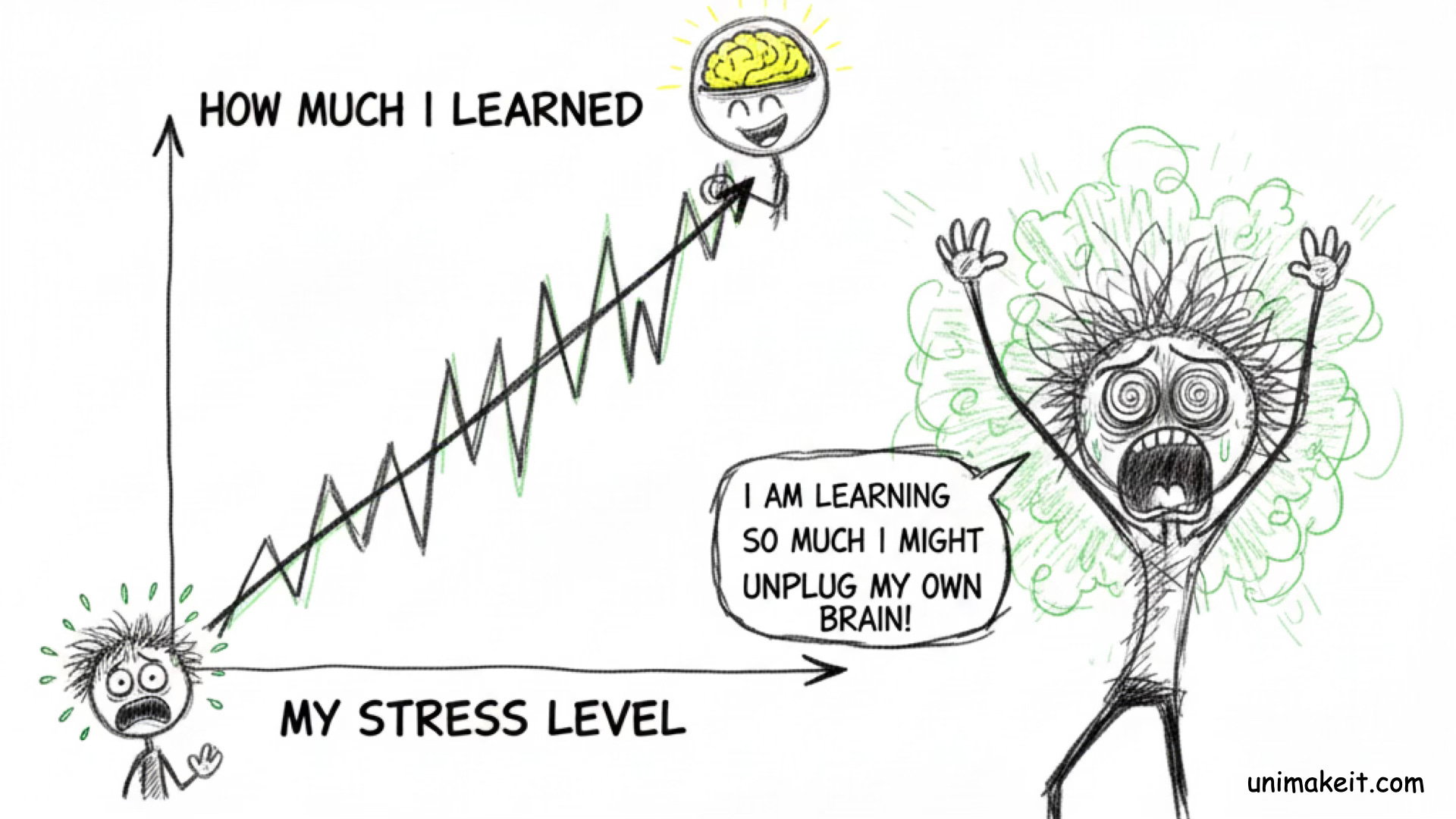
Gilder argues that Growth = Learning, and you can’t learn if you’re just confirming what you already know.
The economy (and your career) grows through the “Learning Curve.” Every time you double your output, your costs should drop by 20-30% because you learned shortcuts.
But you only find shortcuts by tripping over things.
If your week went perfectly according to plan, you generated zero new wealth. You just executed a script.
To upgrade your OS, you have to hunt for the “Surprise Quotient.”
Did something weird happen? Did a client ask a question you couldn’t answer? Did the AI hallucinate a solution you hadn’t thought of?
That “Huh, that’s weird” moment is the only place where value is created.
I’m trying to retrain my brain to stop viewing chaos as a “failure of planning” and start viewing it as “high-bandwidth data downloading.”
It’s terrifying. But apparently, it’s profitable.
To wrap this up:
The old operating system says: Work hard, hoard cash, avoid risk.
The upgraded “Agency of One” OS says:
Time is the real currency. Automate the boring stuff to buy your life back.
Knowledge is the real asset. The atoms don’t matter; the arrangement does.
Surprise is the real teacher. If you aren’t slightly confused, you aren’t growing.
Go out there and find some good surprises today.
Links:
https://www.gilderreport.com
https://www.amazon.com/Life-after-Capitalism-George-Gilder/dp/1684512247


