


Morning, CEO!
It’s December. The year is wrapping up.
My dad just hit day 233 of not smoking (go, Dad!), and I am currently sitting in a fortress of blankets trying to ignore the fact that I’m a 41-year-old introvert who has to interact with humans this holiday season.
Speaking of humans: they are terrible, aren’t they? They’re messy. They have “feelings.” They interrupt your deep work.
If you, like me, sometimes wish you could just upload your consciousness to the cloud and avoid small talk forever, let’s talk about a book that dragged me by the hair back to reality.
It’s called The Schopenhauer Cure by Irvin Yalom.
1. The Optimization Trap (Or: Why Being Right is Lonely)
Meet Philip. Philip is a character in the book, but let’s be honest: Philip is me. And there is a non-zero chance that Philip is you.
Philip is a chemist who optimizes his life for zero pain. He loves Arthur Schopenhauer, the German philosopher who basically said, “Life is a pendulum swinging between pain and boredom, so the only winning move is not to play.”
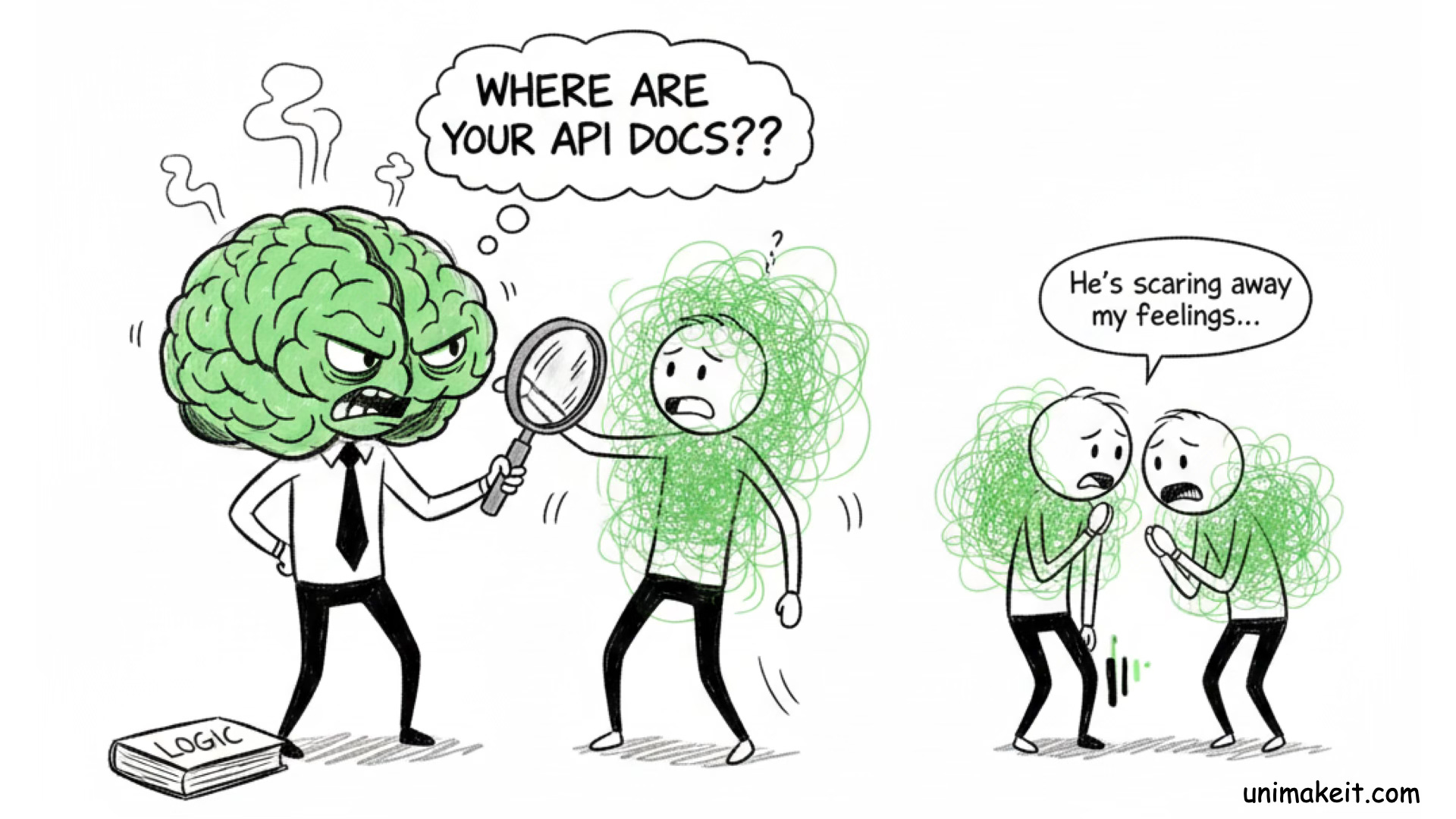
Philip decides that relationships are inefficient. People are just walking bags of irrational needs. So, he isolates himself. He becomes a walking brain in a jar. He is technically “successful,” but he’s about as warm as a server room in Antarctica.
I relate to this hard. As an engineer, I love systems. I love logic. I love things that have a clear input and output.
People? People have undefined variables.
But here is the catch that Yalom throws at us: You cannot debug your life in isolation.
Philip eventually wants to become a therapist (ironic, I know). But his mentor, Julius, tells him he can’t do it unless he joins a therapy group. He has to sit in a room with messy, loud, emotional people.
Philip hates this. He tries to “solve” the group members like they are broken code. He quotes philosophy at them. He analyzes them.
And guess what? They hate him back.
The lesson for us, sitting in our home offices running our one-person shows? You can be the smartest person in the Slack channel. You can have the best data. You can have the perfect strategy.
But if you view your clients, partners, or peers as “inefficiencies” to be managed rather than humans to be understood, you hit a ceiling. Intelligence without connection isn’t leadership. It’s just a really fancy calculator.
2. The “Here and Now” Protocol
So, Philip is in this group, acting like a robot. He keeps talking about the past, or quoting dead philosophers. He is physically present, but mentally, he is in 1850.
Julius, the therapist, introduces a concept called the “Here and Now.”
The rule is simple: We don’t talk about your childhood trauma right now. We don’t talk about your office politics from last week. We talk about what is happening between us, in this room, right this second.
If you feel annoyed by me? Say it.
If you feel dismissed? Say it.
For Philip, this is a nightmare. It forces him to turn off his “Analysis Mode” and turn on his “Feeling Mode.”
I tried to apply this recently. I was in a sprint planning session that was going off the rails. I felt that defensive itch to pull up the contract. I wanted to quote the scope of work. I wanted to share my screen and point aggressively at Jira tickets.
Instead, I tried the “Here and Now.” I looked at the product lead and realized they weren’t trying to be difficult. They were panicking about their quarterly review.
Instead of dazzling them with project management logic, I said, “It feels like there’s a lot of pressure to ship this specific feature by Q4, or heads are going to roll. Is that the real driver here?”
The wall came down. We didn’t need a Gantt chart; we needed to acknowledge the stakes.
As an “Agency of One,” your superpower isn’t your productivity. It’s your empathy. An LLM can optimize a schedule, but it can’t feel the panic hiding behind a feature request.
Stop trying to be a better computer than the computer. Be the human in the loop.
3. Vulnerability is the API for Trust
The climax of the book involves a woman named Pam.
Years ago, Philip seduced Pam, then ghosted her because he was “optimizing his life” and didn’t want attachment. Classic Philip.
Now, they are in the same group. Pam is furious. She wants to destroy him.
But eventually, the anger burns out, and something else emerges.
In a pivotal moment, Philip admits he feels unlovable. He drops the shield. He admits the fortress is empty.
And Pam, instead of stabbing him, says something that floored me: “Philip, I could have loved you.”
Oof.
She didn’t say “I forgive you.” She acknowledged the potential that was lost because he was too afraid to be vulnerable.
We spend so much energy building armor. We call it “professionalism.” We call it “expertise.” We call it “maintaining boundaries.”
But armor is heavy. And armor keeps the good stuff out, too.
In the book, Philip finally heals not because he found the perfect philosophical argument, but because he let someone see his cracks.
For us? Vulnerability is a business asset.
Admitting “I don’t know the answer to that yet,” or “I’m struggling with this part of the project,” or even just “I’m having a rough Tuesday” doesn’t make you look weak. It makes you look trustworthy.
AI hallucinates confidence. Humans build trust through honesty.
To recap:
Don’t be a Philip. You can’t optimize your way out of the human condition.
Stay in the “Here and Now.” Read the emotional data in the room, not just the spreadsheet.
Drop the Armor. Vulnerability is the highest bandwidth connection you have.
Go forth and be a person today. The machine can handle the rest.
Links:
https://www.yalom.com
https://www.amazon.com/Schopenhauer-Cure-Novel-Irvin-Yalom/dp/0060938102


