


Morning, CEO!
I like to think of myself as a rational, logic-driven engineer. A sophisticated machine made of meat, caffeine, and crippling uncertainty about what to do with my arms in public.
But recently, I read The Elephant in the Brain by Kevin Simler and Robin Hanson, and realized my internal operating system is full of hidden bugs.
Actually, they aren’t bugs. They’re features I’m pretending don’t exist.
We like to think we make decisions based on logic, data, and noble intentions. But there is a massive animal in our mental living room dictating our moves, and we are working overtime to ignore it.
Today, let’s debug the hidden motives running your career.
1. The Redwood Tree Delusion
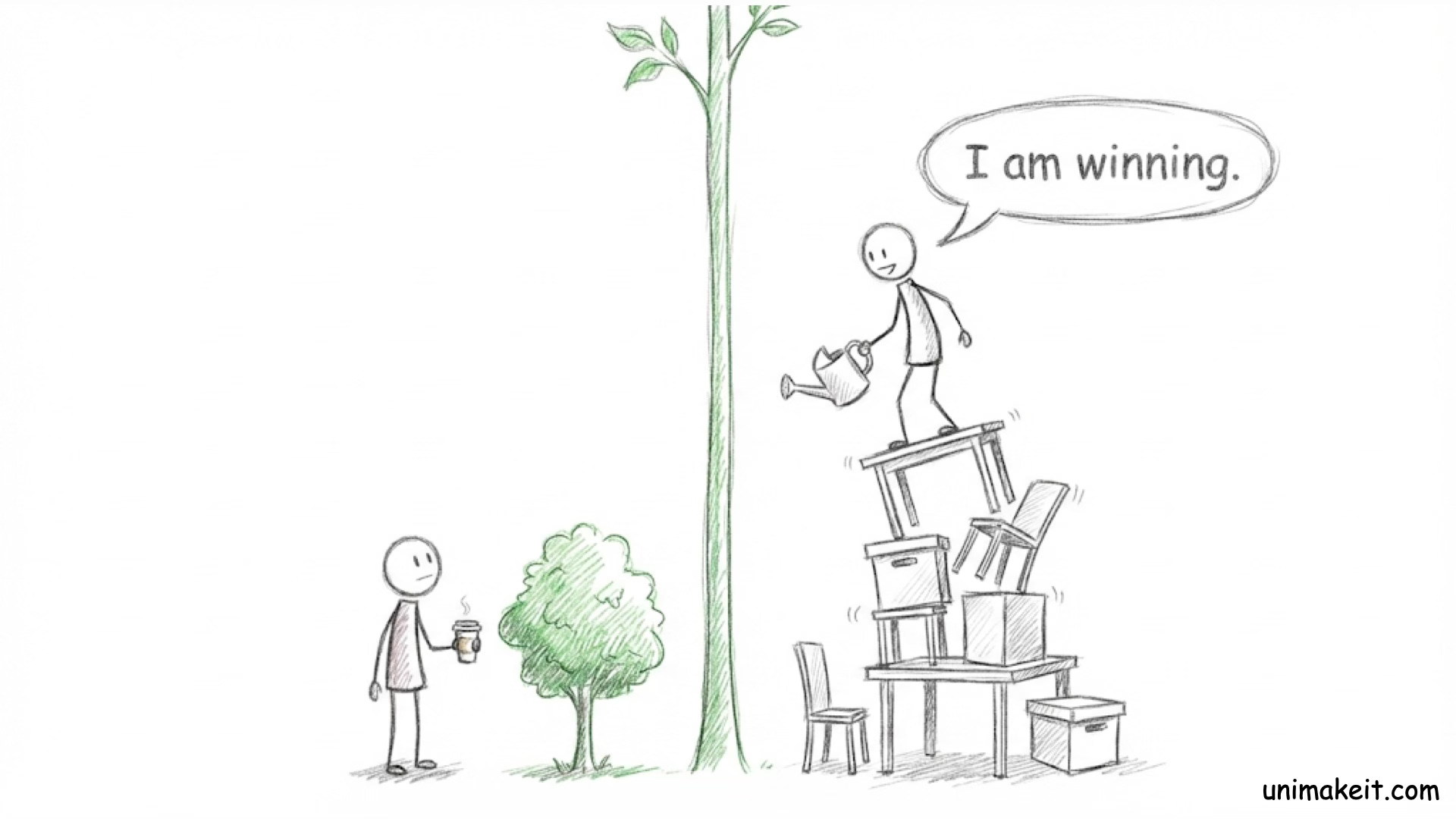
Here is a fact that blew my mind: California Redwoods can grow to 380 feet tall. That is biological insanity. It’s expensive, dangerous, and makes it really hard to get water to the top branches.
Why do they do it? To get more sun?
No. A 20-foot tree gets plenty of sun—if it’s surrounded by 10-foot trees.
Redwoods grow to 380 feet because other Redwoods are 379 feet. They aren’t fighting the sky; they are fighting their neighbors. It is a zero-sum arms race for relative status.
I realized I do this constantly.
I tell myself I’m perfecting a slide deck until 7 PM because “I care about excellence.”
If I’m honest? I’m doing it because I want to look smarter than Dave in the weekly sync.
We treat our careers like a cooperative effort to “grow the pie,” but our brains are wired for a hunter-gatherer status contest where the pie is fixed. We aren’t just trying to succeed; we are trying to succeed more than the person next to us.
This is the “Elephant.”
Recognizing this is a superpower. When you catch yourself in a “Redwood Race”—expending massive energy just to be one inch taller than a peer—you can choose to opt out.
You can stop playing the zero-sum status game and switch to the positive-sum value game. Let Dave have the taller tree. You go build a lumber mill.
2. The Internal PR Department
We all have a Press Secretary living in our frontal lobe.
Its only job is to spin a narrative that makes us look good to the “tribe.”
The book points out a terrifying statistic: If you offer heart surgery patients data on hospital mortality rates for just $50, only 8% buy it.
Why? Because for 92% of us, the hidden motive of going to the doctor isn’t just “get fixed” (which requires data). It’s “feel cared for” (which requires a nice bedside manner). We prioritize the performance of care over the efficacy of the cure, but we’d never admit that out loud.
I looked at my own “business” decisions through this lens and cringed.
Why did I really sign up for that expensive online course?
The PR Release: “To upskill for the AI revolution.”
The Elephant: To buy a shiny credential so people think I’m smart.
Why do we hold so many useless meetings?
The PR Release: “To align on synergy.”
The Elephant: To remind everyone who is in charge and reinforce the pecking order.
As the owner of your career, you have to fire your Press Secretary. Or at least, stop believing their press releases.
When you are about to make a “strategic move”—sending a harsh email, launching a project, buying a tool—ask: What is the ugly, selfish, status-seeking reason I’m doing this?
Usually, that’s the real reason. And once you see it, you can decide if it’s actually profitable or just vanity metrics.
3. Hack Your Own Dashboard
So, do we need to become selfless saints?
Absolutely not. I tried that once for a week. It was exhausting and I didn’t get any work done.
The goal isn’t to delete your hidden motives. The goal is to incorporate them into your strategy so they don’t sabotage you.
Think of it like the “Mona Lisa Test.”
If the original Mona Lisa burned down, but a perfect, atom-for-atom replica survived, would you want to see the replica, or the ashes of the original?
Most people choose the ashes.
Why? Because we don’t actually care about the art (the visual input). We care about the authenticity (the story, the prestige, the rarity).
If you know you are driven by prestige (the ashes) rather than utility (the art), that is fine! But admit it.
If I admit to myself, “I am writing this report because I want praise,” I can optimize for that. I can write a short, punchy executive summary that gets read and praised, rather than a 40-page technical deep dive that gets ignored.
If I lie to myself and say, “I am writing this for the good of humanity,” I’ll write the 40-page bore, get zero feedback, and end up resentful.
Rationality isn’t about being a robot. It’s about knowing your own priority stack.
If you know your brain is a status-seeking monkey, you can give the monkey a banana so it shuts up, letting you get back to the real work.
The Bottom Line
Your brain is running a massive background process called “Look Good to Others.” It eats up a lot of RAM.
By acknowledging the Elephant—our hidden, selfish, status-seeking motives—we stop tripping over it.
You don’t have to be a noble hero. You just have to be an operator who knows exactly where the budget is going.
Links:
https://x.com/kevinsimler
https://x.com/robinhanson
https://www.amazon.com/Elephant-Brain-Hidden-Motives-Everyday/dp/0190495995


