


Morning, CEO!
The year is almost over.
If you are a normal human, you are currently looking at your calendar and wondering how it is possible that eleven months have passed in what feels like forty-five minutes.
Usually, when we try to optimize our lives, we obsess over the “What” (what job should I take?) and the “How” (how do I make the perfect avocado toast?).
But we rarely think about the “When.”
We treat time like a neutral backdrop. We assume 9:00 AM is the same as 3:00 PM. We assume launching a project in January is the same as launching it in July.
I recently read Daniel Pink’s When, and it turns out we are wrong.
Time isn’t a backdrop. It’s a variable. And it’s the one variable we almost always forget to solve for.
Here are three things science says about timing, and why our brains are terrible at managing it.
1. The Beginning: The Zombie Teenager Problem
We love the saying “The early bird gets the worm.”
But biologically, some of us are early birds, and some of us are nocturnal owls who really resent the early morning.
Take high school.
For years, we forced teenagers to learn geometry at 8:00 AM. Science has now confirmed that a teenager’s brain at 8:00 AM is essentially a potato.
When schools pushed start times back by just 30 minutes, everything changed. Grades went up. Depression went down. The students turned back into humans.
But the “Beginning Effect” doesn’t stop after puberty.
There is a terrifying economic study about luck.
Researchers tracked college graduates. They found that if you graduated during a recession (like 1982), your starting salary was obviously lower.
But here is the crazy part:
Two decades later, those people were still earning less than the people who graduated in good years.
It’s a “timing tax.”
If you start a race with a sprained ankle, you don’t just limp for the first mile. You limp for the whole marathon.
2. The Middle: The Universal U-Curve
Middles are weird.
Whether it’s the middle of a project or the middle of a life, things tend to get saggy.
We all know about the “Midlife Crisis.” We tend to view it as a personal failure.
But data shows that happiness follows a specific U-Shape.
20s: High happiness.
50s: The trough of sorrow.
70s: High happiness again.
The bottom of the curve is usually around age 53.
And we aren’t the only ones.
Researchers studied great apes. Do you know what they found?
The apes have midlife crises too.
Around the ape equivalent of age 50, they get grumpy and depressed. They don’t buy sports cars, but I assume they stare at trees with a deep sense of existential dread.
This suggests the “mid-point slump” isn’t because you made bad choices. It’s biology.
The same thing happens in work projects.
Teams usually start excited. Then, in the middle, they hit a wall. They do nothing. They argue.
But there is a silver lining.
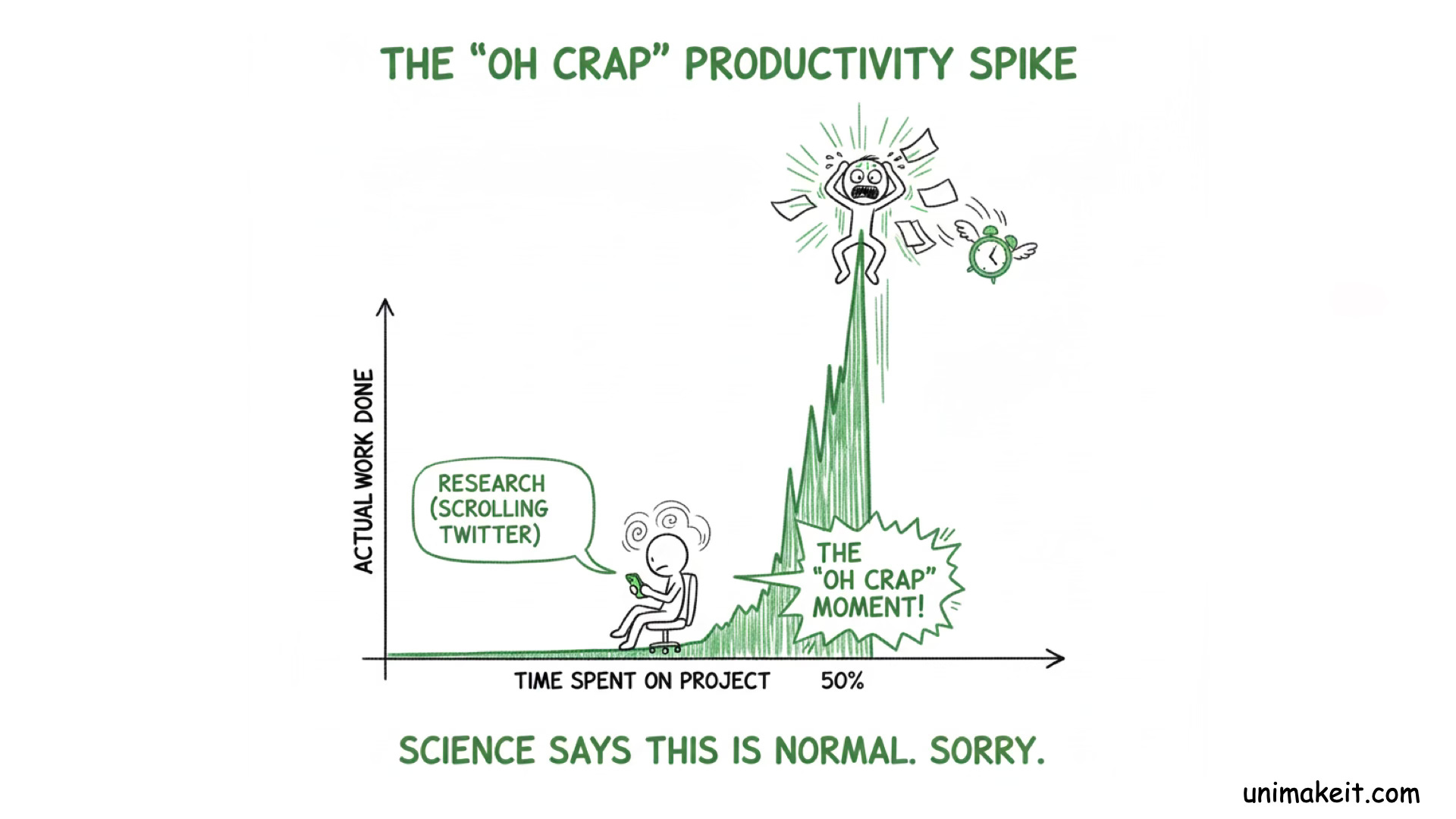
There is a moment called the “Oh Crap Effect.”
When a team realizes they have used exactly 50% of their time, a switch flips. The slump turns into a spike.
3. The End: The “9-Ender” Phenomenon
Humans are obsessed with endings.
We want closure. We want the bow on top.
This is why people run marathons at weird ages.
If you look at first-time marathon runners, there is a massive spike at ages ending in “9.” (29, 39, 49).
Why?
Because we view a decade as a distinct chapter. When we hit 29, our brains scream, “We must achieve something significant before the simulation resets at 30!”
We also treat the end of an experience differently than the rest of it.
In one study, people were given chocolates.
When told, “Here is your next chocolate,” people enjoyed it.
When told, “This is your last chocolate,” people savored it like it was made of gold.
We judge an entire experience based on how it ends. (This is why a bad ending can ruin a great movie).
But here is the insight from a Pixar screenwriter:
Perfect endings are boring.
We think we want the ending where the hero gets exactly what they wanted in the first scene.
But real satisfaction—and good storytelling—comes when the character doesn’t get what they wanted, but gets what they needed.
Think about Up. The old man never gets to live by the falls with his wife. He fails at his original goal.
But he ends up happy anyway.
The Big Picture
So, here we are. November 2025.
We are in the “End Phase” of the year.
This is the time when our brains naturally want to panic about everything we didn’t do, or sprint to the finish line to verify our worth.
But if we look at the science:
Don’t beat yourself up for a bad start. Sometimes the timing was just wrong.
Respect the slump. If you feel stuck, you’re probably just in the middle.
Don’t force a perfect ending. Just try to find a meaningful one.
Timing isn’t magic. It’s just a hidden layer of logic that runs the world.
Now, if you’ll excuse me, I need to go eat a chocolate.
I’m going to tell myself it’s the last one, so it tastes better.
Links:
https://www.danpink.com
https://www.amazon.com/When-Scientific-Secrets-Perfect-Timing/dp/0735210632


