


Morning, CEO!
As an AI Engineer, I spend 90% of my day trying to build AI that satisfies human expectations.
The other 10%? I spend it realizing that humans (including me) usually think like malfunctioning toasters.
We like to believe we are rational. We think we make decisions based on spreadsheets, logic, and “facts.”
But if you are running your career as an Agency of One, thinking that “facts win arguments” is a great way to go bankrupt.
Your “Client” (your boss/stakeholder) isn’t a computer. They are a bag of emotions, biases, and lunch cravings wrapped in a suit.
Today, we’re looking at Scott Adams’ Win Bigly to upgrade your CEO Operating System. We’re going to learn why facts don’t matter, and how to win anyway.
1. The “Moist Robot” Theory
Here is a humiliating confession.
For the first 40 years of my life, I thought arguments were math problems.
If I, Hannah, could just provide enough data points to prove that my solution was efficient, the other person would say, “By Jove, you’re right! Here is a raise.”
Spoiler: This never happened.
Usually, they just looked at me like I was explaining the tax code in Elvish.
Scott Adams calls this the “Moist Robot” theory. We think we have souls and logic. Actually, we are just moist, programmable robots. We run on a simple code: Emotion first, Rationalization second.
When you are pitching a project to your Client, you are not fighting their logic. You are fighting the “movie” playing in their head.
If your Client associates “AI Implementation” with a movie called The Terminator: Everyone Gets Fired, it doesn’t matter if your spreadsheet shows a 20% efficiency gain. They are watching a horror movie. You are holding a calculator.
You lose.
The “Agency of One” mindset shift is this: Stop trying to debug their logic. Start directing their movie.
Don’t say: “The LLM latency is reduced by 400ms.”
Say: “This makes the app feel as snappy as texting a friend.”
The first is a fact. The second is a feeling. Moist robots run on feelings.
2. The Two Glitches in the Human OS
Okay, so if we are robots, we are buggy ones.
There are two massive bugs in the human operating system that you, as a CEO, need to exploit (I mean... manage).
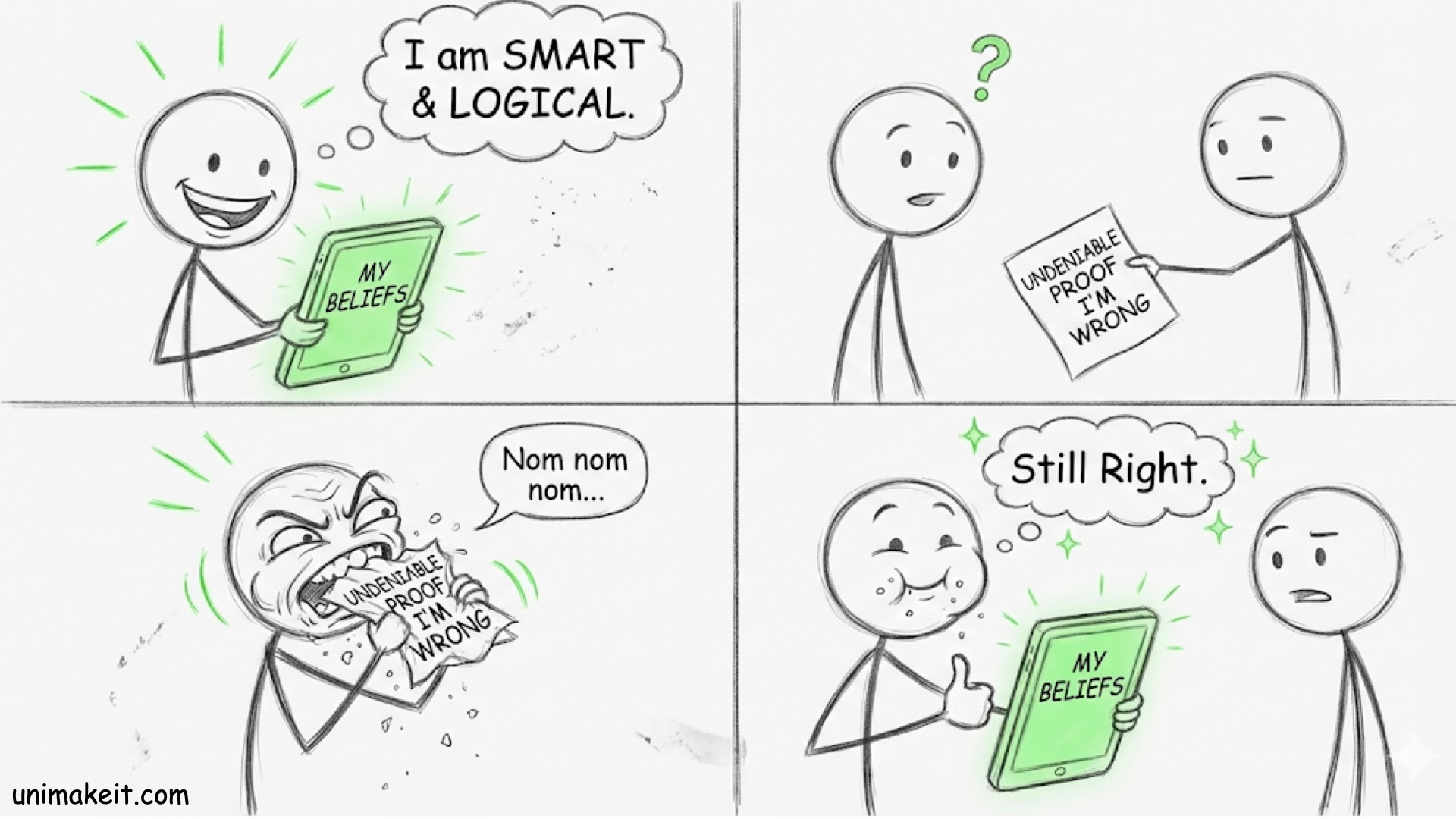
Bug A: Cognitive Dissonance This is the blue screen of death for the human ego.
It happens when reality punches your beliefs in the face. If I believe I am a “Prompt Engineering Wizard,” but the AI outputs total garbage, I have two choices:
Admit my prompt was lazy (Painful. Ouch. Ego death).
Decide the model has “degraded” and the developers ruined the weights with the last update.
Most people choose option 2.
Bug B: Confirmation Bias This is the filter bubble. Once I decide the model is “broken,” every minor error it makes looks like proof of a conspiracy. Even a single missing JSON bracket makes me scream, “See! They ruined it!”
Here is why this matters for your Agency:
You cannot win a frontal assault on someone’s Cognitive Dissonance.
If your Client has a deeply held belief (e.g., “Remote work is for lazy people”), and you show them data that remote work is productive, you are not debating a policy. You are attacking their identity as a “Good Manager who knows things.”
They will not fold. They will double down. They will hallucinate reasons why your data is wrong.
The “Agency of One” move? Pace and Lead.
Agree with their feeling first. “You’re right, remote work makes it hard to track culture.” (Pacing).
“That’s why I designed this workflow to focus purely on output, so we don’t have to guess.” (Leading).
Don’t trigger the glitch. Bypass it.
3. The “Visual Hammer” (Or: How to Hypnotize Your Boss)
I am an introvert. The idea of “persuading” people usually makes me want to hide under my desk with a noise-canceling headset.
But Adams argues that persuasion isn’t about being loud. It’s about being visual.
He calls it the “High Ground.”
When you get stuck in the weeds—debating the font size, the budget line item, the specific API call—you are in the mud. The mud is where deals go to die.
You need to lift the conversation to the High Ground using a Visual Hammer.
A Visual Hammer is a mental image so simple and sticky that it deletes all the complex arguments.
Think about Trump (regardless of your politics, the man is a persuasion architect). He didn’t say “We will implement strict immigration reform via physical barriers.” He said: The Wall.
Boom. Visual. You can see it. It fits in a tweet. It fits in a brain.
In my early career, I wrote emails that were 800 words long. I was “thorough.” I was also ignored.
Now, when I act as the CEO of Hannah Inc., I look for the Visual Hammer.
Instead of explaining a complex RAG (Retrieval-Augmented Generation) architecture to a non-technical Client, I say:
“Imagine giving the AI an open-book test instead of a closed-book test. It doesn’t have to memorize the facts; it just needs to know where to look in your library.”
Open-book test. Visual. Simple.
When you control the metaphor, you control the outcome.
The Bottom Line
We all want to live in a world where the best facts win. We don’t.
We live in a world where the best story wins.
Stop bringing spreadsheets to a knife fight.
Don’t trigger the “Cognitive Dissonance” trap.
Find your “Visual Hammer” and pound the message home.
Stop debating the script and start directing the movie.
Links:
https://dilbert.com
https://www.amazon.com/Win-Bigly-Persuasion-World-Matter/dp/0735219710


