


Morning, CEO!
Here is the situation. It is December. The holidays are looming.
In your professional life, you are a cool, collected operator. You manage budgets. You manage AI workflows. You make high-stakes decisions before your second cup of coffee.
But in about two weeks, you are going to walk through your parents’ front door.
And within 14 minutes, your mother will make a comment about your haircut, or your dad will ask why you haven’t been promoted yet, and—poof.
The professional vanishes. You are suddenly a sulky 14-year-old. You slam a door. You eat your feelings.
Why does this happen? Why is our internal operating system so buggy around the people we love?
Today, we’re looking at Growing Yourself Up by Jenny Brown. We’re going to patch your emotional firmware so you don’t crash this holiday season.
The “Emotional Sponge” vs. The Membrane
I used to think “maturity” meant owning a slow cooker and having a diversified 401k.
Turns out, I was wrong.
According to Murray Bowen’s systems theory, maturity is actually “Self-Differentiation.”
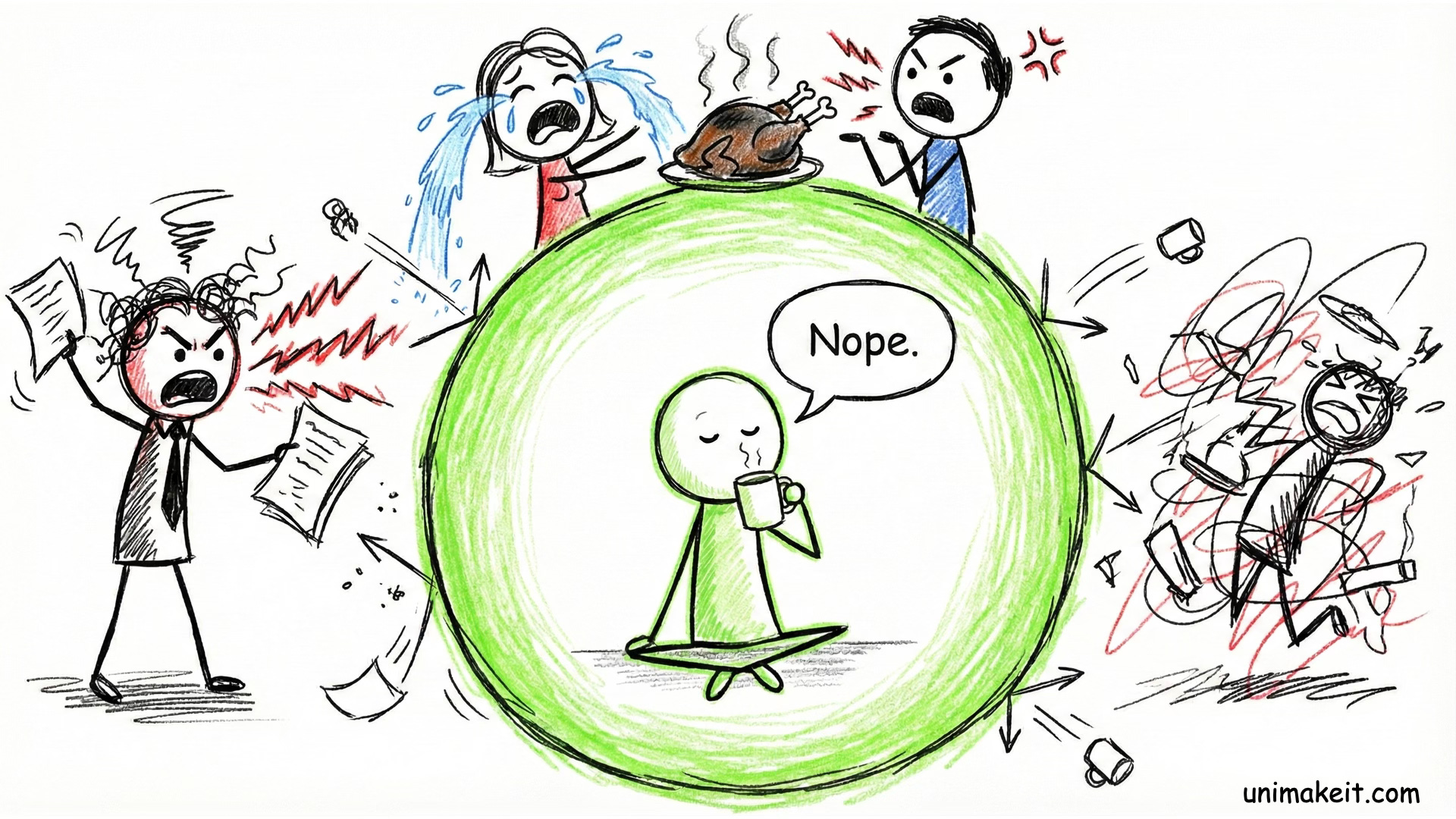
Think of your psyche like a cell.
Most of us—especially me—have very thin, leaky cell walls. We are Emotional Sponges.
If my boss is stressed, I absorb it and become anxious.
If my partner is grumpy, I absorb it and become defensive.
If my mom is critical, I absorb it and feel small.
I have no boundary. The “atmosphere” of the room dictates my internal state.
Differentiation is the ability to grow a semi-permeable membrane. It’s the ability to say: “That is your anxiety. It is over there. I am over here. I can see your anxiety, I can empathize with it, but I do not have to eat it for breakfast.”
This is the hardest thing in the world to do.
When we lack this membrane, we fall into the trap of “Enmeshment.” We try to fix other people’s feelings so we can feel better.
“I need to make Mom happy so I don’t feel guilty.”
“I need to make the client stop panicking so I can stop panicking.”
This is a terrible way to run a business. If your internal stability depends on external validation, you aren’t the boss. The environment is the boss. You’re just the intern running around trying to put out fires with your own tears.
Stop trying to control the weather. Build a better roof.
The “Gossip Triangle” (The Anxiety Hot Potato)
Let’s talk about office politics. Or family drama. They are the same thing, just with different lighting.
When anxiety hits a system, people do something called Triangulating.
It looks like this:
Person A has a problem with Person B.
Person A is too scared/immature to talk to Person B.
So, Person A grabs YOU (Person C) and starts venting.
“Can you believe what Steve did in the meeting? He’s impossible.”
Now, my instinct—my people-pleasing instinct—is to say, “Omg yes, Steve is the worst. I totally agree.”
Why do I do this? Because it feels good. It creates a bond. It lowers the anxiety in the room.
But I have just swallowed the Anxiety Hot Potato.
I have stabilized their relationship by becoming the dumping ground for their stress. I am now part of the problem. I am “triangulated.”
In a high-functioning enterprise (which is you, remember?), this is a productivity killer. It solves nothing. It just spreads the emotional virus.
A differentiated leader does something incredibly awkward. They refuse the potato.
When someone tries to triangulate you, you say:
“Wow, that sounds frustrating. Have you told Steve that?”
The silence that follows will be deafening. It will be uncomfortable.
But that discomfort is the sound of you growing up. You are forcing the anxiety back to where it belongs—between the two people who can actually solve it.
You are not the therapist. You are not the trash can. You are the operator. Keep the lines clear.
The “Second Growth Curve” (or: Why Midlife is Awesome)
If you are like me (a mid-career professional), you might feel like you’re hitting a wall.
The fuel that powered the first half of your life is running out.
That fuel was External Validation.
Gold stars. Good grades. Promotions. “Good girl/boy” points.
We spent decades contorting ourselves to fit into other people’s boxes so they would clap for us.
But eventually, the clapping gets quiet. Or you realize you don’t care about the clapping anymore. This is what people call a “Midlife Crisis.”
But Jenny Brown calls it the Second Growth Curve.
The first growth curve is physical and social—learning to walk, talk, and fit in.
The second growth curve is internal—learning to stand out and stand firm.
This is where the real work begins.
This is the transition from “You make me feel...” to “I choose to feel...”
For those of us building our own solo empires, this shift is critical. There is no HR department to validate you. There is no teacher to give you an A.
You have to generate your own gravity.
If you are still operating on the “Please Like Me” operating system, you will burnout. You will chase the wrong clients. You will undercharge because you’re afraid of rejection.
The “Value Crisis” of midlife isn’t a bug. It’s a feature. It’s the system forcing you to switch from solar power (relying on others’ light) to nuclear power (generating your own energy).
It’s terrifying. But it’s the only way to fly the ship.
The TL;DR
Maturity isn’t a destination where you arrive and suddenly love jazz and never get angry.
It’s a direction. It’s a muscle.
This holiday season, treat your family dinner like a laboratory.
When the anxiety spikes, when the old triggers get pulled, just pause.
Visualize your membrane.
Don’t eat the hot potato.
And remember: You can’t change them. You can only change you.
(And if you fail and eat an entire pie in the pantry? That’s okay. We try again tomorrow.)
Links:
https://www.facebook.com/drjennybrown
https://www.amazon.com/Growing-Yourself-Up-bring-relationships/dp/145963327X


