


Morning, CEO!
It’s December 2025. If you’re anything like me, you are currently staring at a list of New Year’s Resolutions that looks suspiciously similar to the list you made in 2015.
I treat my life like a buggy codebase. I assume if I just patch enough lines of code—drink more green juice, download a better To-Do app, wake up at 4 AM—the system will finally run smoothly.
But I recently read a book from the 70s called Change that basically told me my “patches” are actually the malware.
The “Try Harder” Trap
Let me tell you a story about a grumpy old soldier.
He’s a tough guy. He survived wars. But in his old age, he meets an enemy he can’t kill: Insomnia.
He treats sleep like a combat mission. He lies in bed, veins popping on his forehead, screaming internally: “I WILL SLEEP NOW. ENGAGE SLEEP PROTOCOL.”
Obviously, he stays wide awake, staring at the ceiling, feeling like a failure.
He goes to a therapist who says something insane: “I bet you’re actually asleep and just don’t know it.” The soldier gets so offended by this accusation that he decides to go home and prove the doctor wrong. He vows to stay awake the entire night, just out of spite.
He gets in bed, eyes wide open, determined to not sleep a wink.
And he passes out immediately.
This is the core of the book. The authors—some very smart guys from the Mental Research Institute—point out that for most human problems, the solution is the problem.
I do this constantly with writing. I want the draft to be perfect, so I edit every sentence as I write it. I delete. I rewrite. I criticize. The “solution” (high standards) cripples the flow, and I end up with three perfect sentences after four hours, instead of a finished messy draft.
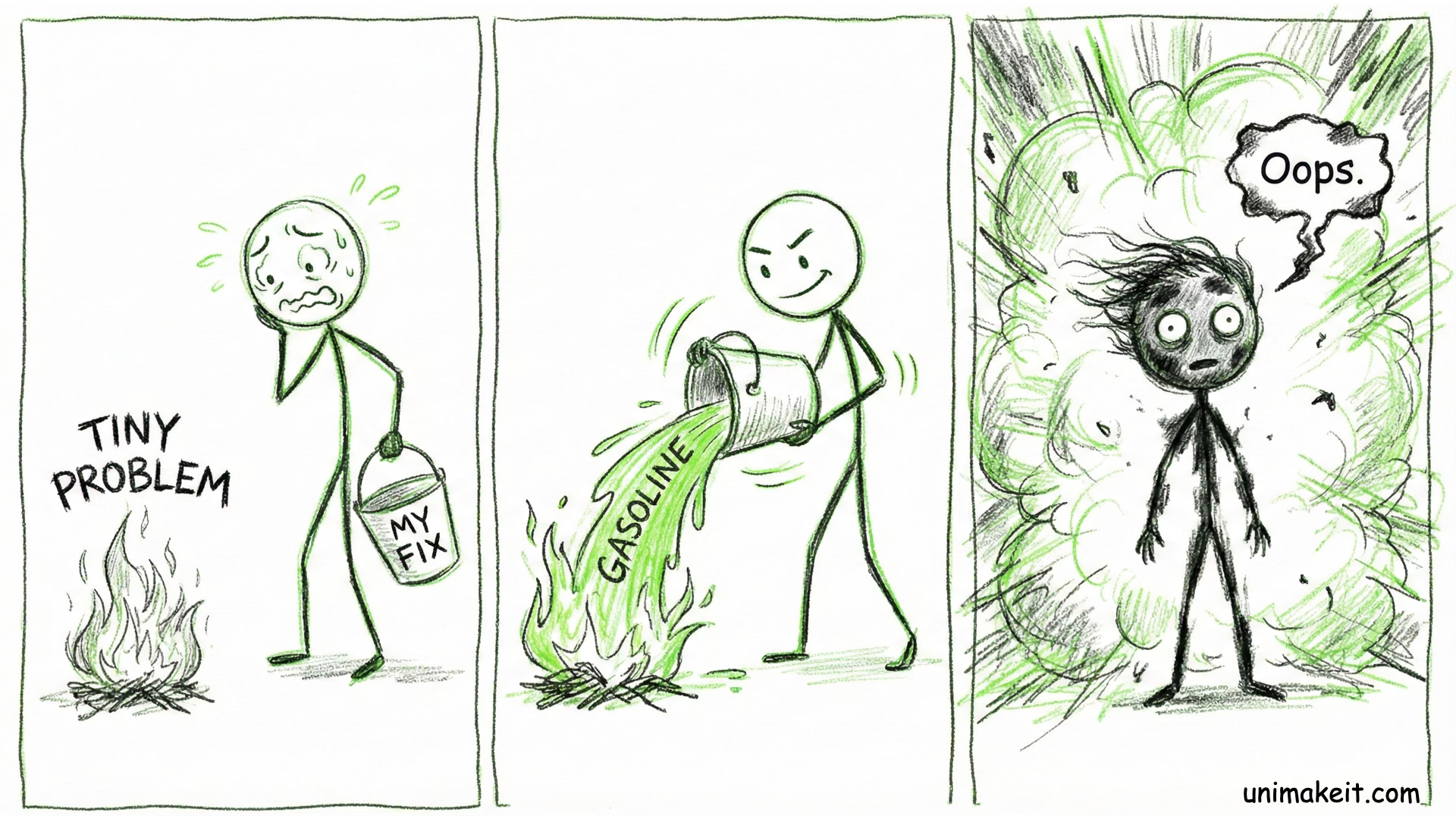
If you are currently struggling with a project or a difficult stakeholder, ask yourself: Is your method of fixing it actually the gasoline on the fire?
Running Inside the Nightmare
The book splits change into two types: First-Order and Second-Order.
First-Order Change is what happens in a nightmare.
Let’s say you’re dreaming that a giant, sentient Excel spreadsheet is chasing you. You run. You hide. You climb a tree. You try to fight it with a calculator.
You are doing a lot. You are sweating. You are trying new tactics. But you are still trapped, because all your actions are consistent with the logic of the dream. You are running faster, but you’re still on the hamster wheel.
Second-Order Change is waking up.
Waking up is the only way to escape the spreadsheet monster. But here’s the kicker: “Waking up” makes zero sense from inside the dream. It’s a leap to a totally different system.
Most of us spend our careers doing First-Order Change.
The Problem: You are invited to a useless recurring meeting.
First-Order Fix: Go to the meeting, but multitask on your laptop while nodding occasionally. (The hamster wheel spins faster).
Second-Order Fix: Send a note asking, “What specific input do you need from me?” If they can’t answer, you don’t go. (Stepping off the wheel).
If you feel stuck, it’s usually because you’re trying to run faster inside the nightmare. You’re trying to be a “better” employee within a broken system, instead of changing the rules of the system entirely.
The Jedi Mind Trick (Reframing)
So, how do we wake up? We have to do something the book calls Reframing.
I call it “lying to your brain until it chills out.”
Reframing means changing the context of the problem so the “facts” mean something totally different.
The book gives a great example of a perfectionist employee. This guy was terrified of making mistakes. He checked his work ten times. He was miserable and slow.
The therapist didn’t tell him to “relax.” That’s First-Order advice (and never works).
Instead, the therapist gave him a mission: You must intentionally make one small mistake every single day.
The employee was terrified, but he did it. He sent an email with a typo. He wore unmatched socks.
And guess what? The world didn’t explode. His boss didn’t fire him.
By framing the mistake as a deliberate assignment, the therapist took away the fear. The “mistake” stopped being a monster under the bed and became a pet Chihuahua he could control.
You can do this with your “clients” (aka your bosses).
If you have a stakeholder who micromanages you because they don’t trust you, the instinct is to push them away (First-Order).
The Second-Order Reframe: Overwhelm them with inclusion. Ask for their opinion on everything. CC them on every tiny thought. Flood them with “transparency” until they beg you to stop and just handle it yourself.
You change the frame from “Parent/Child” to “I am annoying you with my competence.”
The Bottom Line
Life isn’t a logical puzzle; it’s a weird ecosystem.
If you’re banging your head against a wall, buying a more expensive helmet isn’t the answer.
Stop trying to solve the problem. Instead, try to ruin the problem. Do the opposite. Stay awake to fall asleep. Fail on purpose to succeed.
Stop running in the dream.
Wake up.
Links:
https://europeanfamilytherapy.eu/paul-watzlawick
https://europeanfamilytherapy.eu/john-weakland
https://europeanfamilytherapy.eu/richard-fisch
https://www.amazon.com/Change-Principles-Problem-Formation-Resolution/dp/0393707067


