


Morning, CEO!
If you are anything like me, you have a To-Do list that is currently staring at you with judgment.
You are busy. I am busy. We are all very important people doing very important things, like optimizing our email signatures and worrying about whether we bought the right kind of oat milk.
But Neil deGrasse Tyson wrote a book called Astrophysics for People in a Hurry, and it stayed on the New York Timesbestseller list for a long time.
This implies that deep down, even while we are stressing about Q4 KPIs, we actually want to know how the universe works.
I read it. It made my brain hurt.
But it also gave me a “Cosmic Perspective.”
This is a fancy way of saying it made me realize that my problems are very small, and also that I am made of nuclear waste.
1. The Universe uses the same LEGO set everywhere.
The Big Idea: The laws of physics are universal.
Back in the day, people thought the sky was a magical realm where the rules were different. Like a VIP lounge at a club I can’t get into.
Then Newton came along and ruined the magic. He realized gravity works the same way on an apple as it does on a planet.
Then, later scientists looked at the light coming from the sun (spectroscopy). They realized the sun is made of hydrogen, carbon, oxygen, nitrogen.
You know where else you find that stuff? Here. In dirt. In clouds. In my breakfast burrito.
This is actually huge.
It means if aliens land on Earth tomorrow, they won’t be made of “magic.” Their spaceship will be built from the same Periodic Table we use.
I find this comforting.
If an alien abducts me, I can at least bond with them over how carbon-based life forms are high maintenance.
“Oh, you need oxygen too? Tell me about it. I get so cranky without it.”
2. We have no idea what is going on.
The Big Idea: Dark Matter.
So, gravity is a thing. We get it. Objects attract other objects.
But in the 1930s, an astronomer named Fritz Zwicky looked at some galaxies spinning around a cluster.
He did the math. (I did not check his math, but let’s trust him).
He realized the galaxies were moving way too fast. They should have flown apart. There wasn’t enough visible “stuff” (stars, planets, gas) to hold them together with gravity.
Something invisible was holding the galaxy together.
Scientists call this Dark Matter.
It doesn’t interact with light. We can’t see it. We can’t touch it. But it is 85% of the gravity in the universe.
Basically, the universe is mostly made of stuff we can’t find.
This means that right now, heavy, invisible particles are passing straight through your body without you feeling a thing.
We assume we are the “normal” stuff, but Tyson points out that we - the visible, touchable matter - are actually the freakish minority.
Scientists are literally digging holes in the ground just to get one particle to say hello, but they still haven’t found any.
3. The Universe is ghosting us.
The Big Idea: The expansion of the universe.
Einstein originally thought the universe was static. Just sitting there. Chilling.
Then Edwin Hubble (the telescope guy) realized that galaxies are moving away from us. The universe is expanding.
If you rewind the tape, everything was once smashed into a tiny dot. That’s the Big Bang.
In 1998, scientists found out the expansion isn’t just happening; it’s accelerating.
Something is pushing the universe apart, faster and faster. Scientists call this Dark Energy.
(I don’t know where my other sock went? Dark Laundry.)
This means that eventually, all the other galaxies will be pushed so far away, faster than the speed of light, that we won’t be able to see them anymore.
The night sky will be empty.
It’s basically the ultimate ghosting. The universe is swiping left on us, forever.
Also, because of this expansion, we are technically isolated in our own little pocket of space.
This is exactly how I feel when I cancel plans to stay home and watch Netflix, but on a cosmic scale.
4. The Cosmic Perspective (A.K.A. The Ego Death).
The Big Idea: We are stardust.
This is the part that is supposed to make you cry.
The heavy atoms in your body—the calcium in your bones, the iron in your blood—were forged in the hearts of high-mass stars that exploded billions of years ago.
You are literally made of star guts.
This connects you to the universe in a literal way.
Neil deGrasse Tyson says this gives him a sense of freedom. It makes him realize his ego is unjustified.
He says, “When I track the orbits of asteroids, I sometimes forget that there are people on Earth fighting wars over lines on a map.”
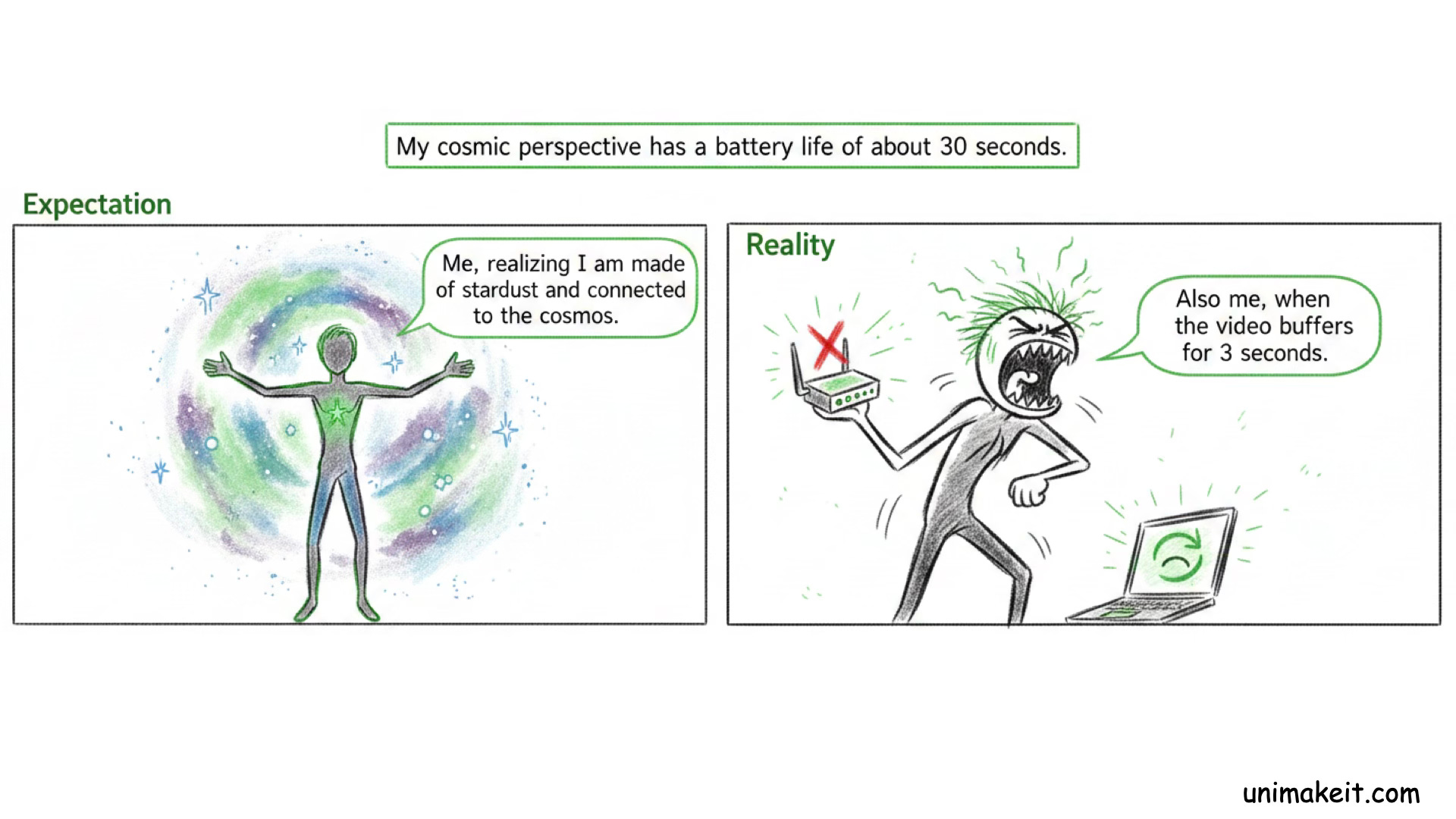
When I read this, I felt very profound for about thirty seconds.
I thought, “Wow. I am the universe experiencing itself. I am infinite.”
Then my WiFi stopped working.
And immediately, I lost the Cosmic Perspective.
I was not a majestic child of the stars. I was a rage-filled potato screaming at a router.
But that’s the point.
The Cosmic Perspective is a reminder.
We are insignificant. We are tiny. The universe is 13.8 billion years old, and I am upset because my coffee is lukewarm.
It’s humbling.
It reminds me that the universe is not here for me.
Which is good, honestly. Because if the universe was designed for me, there would be way fewer black holes and way more naps.
The Summary
Physics is everywhere. The rules apply to everyone, even aliens.
Dark Matter is real. Most of the universe is invisible, just like my motivation on a Monday.
The Universe is expanding. Everything is moving away from everything else.
We are stardust. Act like it (but maybe don’t explode).
Now, I’m going to go stare at the sky and pretend I understand Dark Matter until I get hungry.
Links:
https://neildegrassetyson.com
https://www.amazon.com/Astrophysics-People-Hurry-deGrasse-Tyson/dp/0393609391


